I posted a single line on LinkedIn that named Accenture's roughly 786,000-person headcount against the revenue it earns — and it reached 241,794 people. The number did the work. Not because it was a jab at consulting, but because it made a structural truth visible in one figure: some business models turn revenue into people, and some turn it into leverage. Once you see that split, you cannot unsee it.
I spent years inside businesses built the first way before I left to build one built the second way. What follows is the honest version of the difference — not a hot take about AI replacing jobs, but the mechanics of it: why labor-heavy models cap out, why leverage-native ones compound, and what the whole thing means for anyone deciding how to build.
Why the consulting model needs so many people
Start with the obvious, because the obvious is the point. A firm the size of Accenture employs hundreds of thousands of people because the product is people. It sells expert hours. The only way to sell more hours is to employ more experts. That is not a flaw or an inefficiency — it is the model working exactly as designed. The headcount is the inventory.
The trouble is what that model does to your future. When the product is human hours, three things are locked in from the start.
- Growth requires proportional hiring. To double revenue, you roughly double the people. There is no version where output leaps ahead of headcount, because output is headcount times utilisation times bill rate.
- Margin is bounded. You can push utilisation and rates, but only so far. A labor business has a ceiling on profitability that no amount of excellence breaks through — the cost of the next unit of revenue is another salaried expert.
- Nothing compounds. Every engagement starts near zero. The work done for one client does not lower the cost of the work for the next. You are always paying full price for capacity, every quarter, forever.
786,000 people is not a scandal. It is what a business looks like when the only lever it has is hiring — and it is the clearest picture you will ever see of a model that cannot compound.
What "leverage-native" actually means
The opposite of a labor-heavy business is not a smaller one. It is one that converts revenue into leverage — software, systems, and increasingly AI that do the marginal work instead of a new hire doing it. The defining question of ai leverage vs headcount is simply this: when demand goes up, do you reach for another person, or does the system you already built absorb it?
In a leverage-native company, output and headcount diverge. A small team ships work that would have required an army in the old model, because the repeatable part of the work — the drafting, the tracing, the reconciling, the producing — runs at machine scale, and the people spend their hours building and steering the machine instead of being the machine. That divergence between headcount and output is the entire signature of a leverage business, and it is why a handful of people can now carry revenue that used to take a floor of them.
Why leverage compounds and labour doesn't
The reason this matters so much is not that leverage is cheaper per unit — though it is. It is that leverage compounds and labour does not. A system you build once keeps working. The second customer is cheaper to serve than the first, the tenth cheaper than the second, because the fixed cost of building the system is already paid and the marginal cost of running it trends toward nothing.
Labour is the reverse. The second customer costs roughly what the first did, because you served them with a person and the next one needs another person. This is the deep asymmetry hiding inside the 786,000 number: one model gets structurally cheaper as it grows, the other stays flat. Over enough time that is not a small edge. It is the difference between a business with a ceiling and a business with a slope.
What the headcount trap means for founders and operators
If you are building something, this is not abstract — it is a decision you are making right now, whether you notice it or not. The model you pick on day one sets your ceiling.
- Decide the model before you decide the offer. If every new customer requires new headcount, you have chosen a linear, capped, low-margin future no matter how good the work is. Ask where the marginal work goes — to a person, or to a system — before you write the first line of a pitch.
- Treat headcount as a signal, not a trophy. Growing the team is celebrated by default; it should be scrutinised. Every hire that exists to add capacity rather than to build leverage is a small vote for the labor-heavy future. Small teams with outsized output are the goal, not the exception.
- Build the system that does the work, then sell its output. The leverage-native founders winning attention right now are the ones who built the machine first — often by running it on themselves — and sell the outcome, not the hours. That is a positioning advantage as much as an economic one.
This is also why the operators who win the room right now are the ones naming the structural truth out loud instead of pitching around it. The most-read commentary on Accenture's headcount was not an insult to consulting — it was pattern recognition, and the people building the other kind of company recognised themselves in it instantly.
Building the leverage-native way?
The founders and operators who feel this are already in your LinkedIn engagement — reacting to the posts that name their reality. See where you stand — a free, personalized LinkedIn visibility audit + blueprint in your inbox within 48 hours. No card, no call.
Book a call →Why this post did 241,000 impressions — the anatomy
The argument above started as a single LinkedIn post that reached 241,794 people. It was not luck, and it was not reach-hacking. It followed a repeatable structure that any founder or operator can copy to build pipeline and credibility. Here is the teardown.
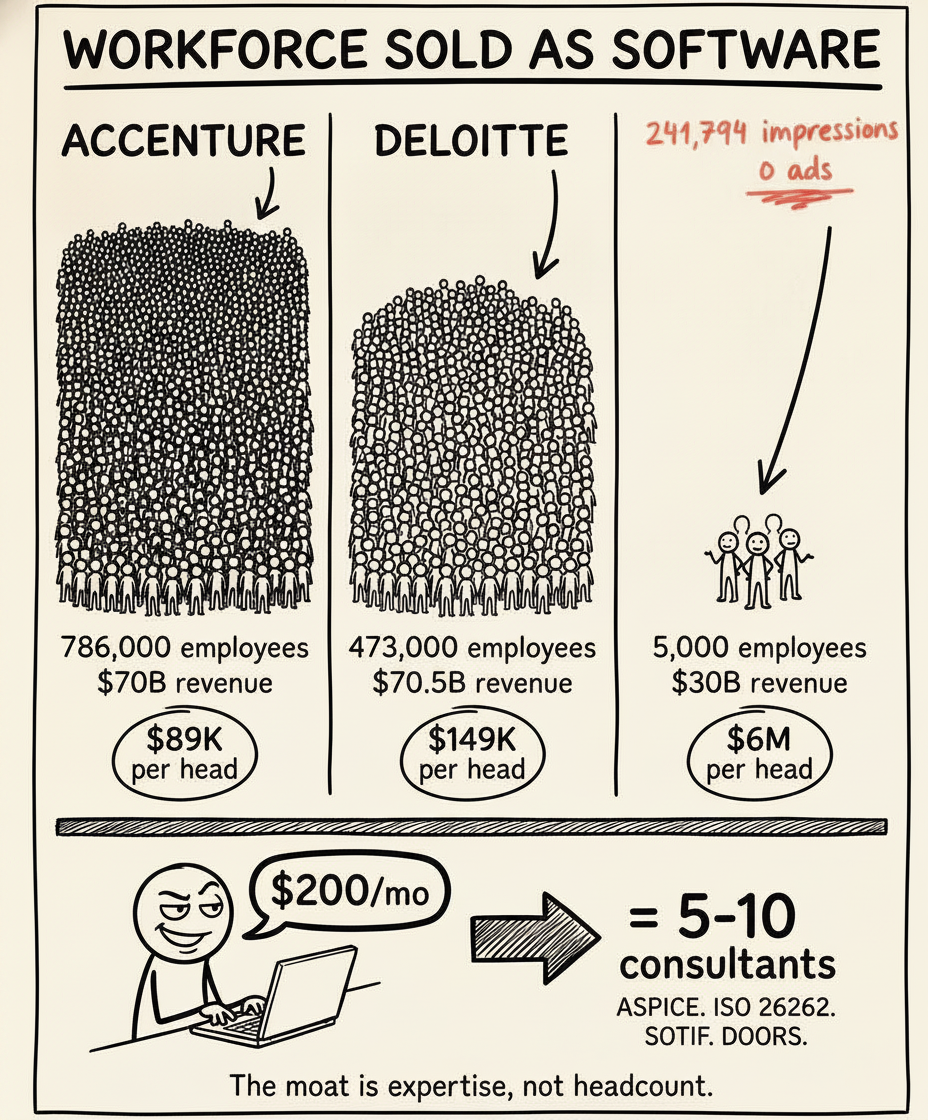
- The hook is one hard number. "Accenture needs 786,000 employees to make its revenue." One figure, one named subject, and the whole argument compressed into it. No adjective does any work — the number does all of it. Answer-engines and humans both reward this because it is unambiguously extractable and instantly legible.
- The structure is fact → pattern → cause → consequence. One striking figure, then the pattern it belongs to (labor-heavy models everywhere), then the structural cause (the product is people), then what it means for the reader. That arc keeps a sharp audience reading past the hook without a single clickbait move.
- The data is named and unhedged. A real company, a real order of magnitude, no "some large firms may be facing structural headwinds." Precision is the credibility. People recognise the shape of the number instantly, and that recognition is what makes them comment and reshare.
- The point of view is earned, not borrowed. "I spent years inside businesses built this way." Insider authority beats outside analysis every time — it is the difference between commentary an operator scrolls past and commentary they forward to their co-founder.
- The restraint is the multiplier. No link in the body, no CTA, no "DM me." Pure value, let recognition do the work — the funnel link lives in the first comment. A post that asks for nothing gets shared; a post that sells gets skipped.
Virality on structural content is not volume or luck. It is one true, specific number, told with earned authority, that lets the right people recognise their own reality — and then raise their hand.
The recipe: recreate this for your industry
This is the copy-paste part. Drop these prompts into Gemini or Claude, swap in your sector, and you have the same structure working for your own pipeline. The visual step is where most people leave value on the table — do not skip it.
- Find the story. "You are an industry analyst in [my sector]. List 5 moments where a single hard number exposes a structural truth about a business model — a headcount figure, a revenue-per-employee ratio, a margin that only works one way, a cost that scales linearly with growth. For each: the number, the named subject, and why an insider would find it significant. Rank by how many people in the industry would recognise it instantly."
- Write the hook. "Turn number #1 into a single opening line: one hard number, one named subject, under 12 words, zero adjectives. Give me 5 variants."
- Build the post. "Write a LinkedIn post using this arc: shocking number → the pattern it belongs to (name 2 more real examples) → the structural cause → what it means for [my reader]. First person, earned POV ('I spent years inside…'), named data, no hedging, no CTA, no link in the body. 180–220 words."
- Make the visual value drip. "Here is a screenshot of the source data or headline. Using image editing, annotate it like a marked-up page: circle the key number in coral, hand-draw an arrow to the second data point, add one short margin note in my handwriting-style font. Keep it looking real and captured, not like a slick data-viz card." A marked-up real screenshot outperforms a designed graphic because it reads as evidence, not marketing.
- Place the funnel link in the first comment — never the body — with your UTM parameters, so the reach compounds into tracked pipeline instead of leaking away.
Where this sits
The way to win right now is to say the true thing clearly and let the people living it raise their hands — then work the ones who do. That is the core of founder-led GTM for deep-tech startups, and the mechanics of turning that recognition into pipeline are in turning LinkedIn engagement into B2B pipeline. And if the leverage question itself is what you are chasing, the numbers behind it are in revenue per employee at AI-native companies.
FAQ
What is the difference between a labor-heavy and a leverage-native business?
A labor-heavy business turns revenue into people — to earn more it hires more, because the product is human hours. A leverage-native business turns revenue into software and systems that do the work, so output grows without a matching rise in headcount. The tell: labor-heavy models see headcount and revenue climb together; leverage-native ones see them diverge.
Why does the consulting model need so many people?
Because the product is people. Selling more expert hours means employing more experts, which is why headcount runs into the hundreds of thousands. It is the model working as designed — but it caps out: growth needs proportional hiring, margin is bounded, and nothing compounds.
Does AI leverage mean firing everyone?
No. Leverage is about what does the work, not cutting people for its own sake. A leverage-native company still has people — but they build and steer systems that produce output at machine scale instead of producing it by hand. The winners are small teams with outsized output, not empty offices.
What does the headcount trap mean for founders and operators?
The model you choose on day one sets your ceiling. Build a business where every new customer needs new headcount and you have bought a linear, capped, low-margin future. Build one where software and AI absorb the marginal work and output compounds — so leverage is a day-one structural decision, not a later optimisation.
More on the engine behind this content: the loop — ingest, publish, mine, extract, reconcile, re-steer. One flat price, we ran it on ourselves first.