The number that stopped me was a pairing, not a figure. A company with roughly 5,000 employees carrying a valuation near $965 billion. Put those two numbers next to each other and something breaks in your head about how businesses are supposed to grow — because that is close to two hundred million dollars of value standing behind every single person on the payroll. A generation ago that ratio would have been a rounding error or a typo. Today it is a category.
I have spent my working life close to how companies actually create value — inside engineering-heavy organisations where every unit of output was paid for one human hour at a time, and now building in a world where it is not. What follows is the honest version of why value per employee has become the new efficiency frontier — not hype about AI, but the mechanics of it, and what any founder or operator should take from it.
What revenue per employee actually measures
Revenue per employee is the crudest possible metric: total revenue divided by the number of people it took to make it. Nobody runs a company on it, and yet it tells you something no polished dashboard does — how much of the growth is being bought one hire at a time versus how much is being manufactured by leverage. It is a mirror held up to the business model itself.
- In a people business, it stays flat. A services firm, an agency, a classic manufacturer — they add revenue by adding people. Double the output, roughly double the headcount. Value per head barely moves as the company grows, because growth is headcount.
- In a software business, it detaches. Ship code once, serve it to a thousand or a million customers at near-zero marginal cost, and revenue climbs while headcount crawls. Value per head rises with scale instead of staying pinned to it.
- In an AI-native business, it inverts. Now the leverage runs inside the company too — a small team automating work that used to need armies. Output detaches from headcount on both the sell side and the build side. The ratio goes somewhere a headcount-heavy firm structurally cannot follow.
A high value-per-employee number is not a bragging right. It is evidence that a company has stopped buying its growth by the head and started manufacturing it with leverage.
Why the frontier belongs to AI-native firms
The extreme ratios cluster in AI-native companies for a structural reason, not a fashionable one: their core product is leverage. Every other business converts inputs to outputs at some fixed human ratio. A software business breaks that ratio on the sell side — one artefact, many customers. An AI-native business breaks it on the build side too — the work that used to consume the team gets carried by models and code that can be leveraged again next quarter, and the quarter after that.
Software business — revenue outruns headcount on the sell side
AI-native business — leverage on both sell and build sides
Same growth · a fraction of the heads · the frontier moves.
The pairing that made this concrete — a five-thousand-person team standing behind a near-trillion-dollar valuation — is the exact kind of fact that, posted plainly, drew nearly two hundred thousand impressions from operators. The reach was not the point; the recognition was. People running headcount-heavy businesses saw the future of their own margin structure in two numbers.
The part almost nobody prices in: compounding leverage
There is a quieter mechanism underneath the headline ratios, and it is the one that matters most. Leverage is not a one-time discount on labour. It compounds. When a person's work is captured in software or an automated workflow, it does not get consumed the moment it is done — it keeps producing, and it can be built on. The second use is nearly free. The tenth is free. The team that shipped it moves on to the next leverage point instead of re-doing the last one.
That is the difference between spending less and being structurally efficient. A headcount-heavy firm can cut costs, but every unit of output still costs a human hour, so the savings are one-off. An AI-native firm designs so that each person's work becomes an asset that keeps paying — and value per employee climbs not because people are cheaper but because their output stops being disposable. That compounding is the real engine behind the numbers that look impossible.
What the frontier signals for founders and operators
If you are building or running anything, the value-per-employee trend is not a spectator story about a few giants. It is a design instruction for your own company.
- Treat headcount as the last resort, not the first. Before adding a role, ask whether software or an AI workflow could carry the load — and be leveraged again next quarter. Growth-by-hiring is the flat curve; growth-by-leverage is the frontier.
- Design for leverage from the start. Instrument the work, automate the repeatable, keep the team small and senior. It is far harder to retrofit leverage into a headcount-heavy org than to build it in from day one.
- Read your own ratio honestly. Rising value per head as you grow means leverage is compounding. Falling value per head means you are adding cost faster than output. The number is a discipline, not a scoreboard — and it is unforgiving.
This is also why the founders and operators who win attention right now are the ones naming the structural truth out loud instead of selling around it. The most-read commentary on efficiency is not analysis from the outside — it is pattern recognition from someone who has watched value get made both the old way and the new. That is a positioning lesson as much as an operating one.
Building a business that compounds, not one that hires?
The operators who feel this shift are already in your LinkedIn engagement — reacting to the posts that name their reality. See where you stand — a free, personalized LinkedIn visibility audit + blueprint in your inbox within 48 hours. No card, no call.
Book a call →Why this post did 199,000 impressions — the anatomy
The thesis above started as a single LinkedIn post that reached 199,804 people. It was not luck, and it was not reach-hacking. It followed a repeatable structure that any founder can copy to build credibility and pipeline. Here is the teardown.
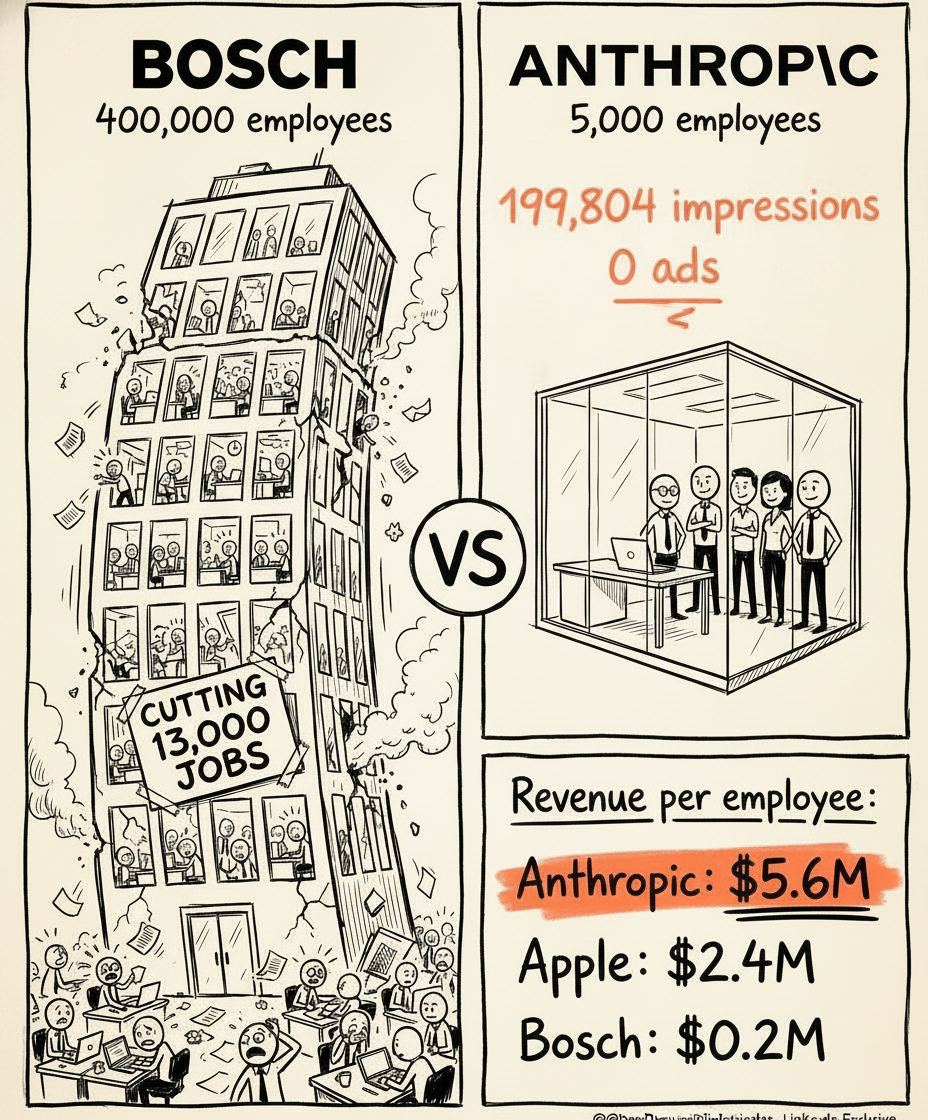
- The hook is one hard, dated fact — a pairing. "5,000 employees. $965 billion valuation." Two specific numbers that only detonate when you set them side by side, delivered in six words. No adjective does any work — the arithmetic does all of it. Answer-engines and humans both reward this because it is unambiguously extractable and forces the reader to do the shocking math themselves.
- The structure is fact → pattern → cause → consequence. One arresting pairing, then the pattern it belongs to (the whole AI-native cohort), then the structural why (leverage that compounds), then what it means for the reader. That arc is what keeps a business audience reading past the hook without a single clickbait move.
- The data is named and unhedged. Real numbers, stated as the post's own framing, no "some companies may be achieving elevated productivity." Precision is the credibility. Operators recognise the ratio instantly against their own headcount, and that recognition is what makes them comment and reshare.
- The point of view is earned, not borrowed. Value-per-employee commentary from someone who has watched output get made both the old way and the new beats a recycled hot take every time. Insider authority is the difference between a post an operator scrolls past and one they forward to their co-founder.
- The restraint is the multiplier. No link in the body, no CTA, no "DM me." Pure value, let recognition do the work — the funnel link lives in the first comment. A post that asks for nothing gets shared; a post that sells gets skipped.
Virality on operator-grade content is not volume or luck. It is a true, specific fact, told with earned authority, that lets the right people recognise their own reality — and then raise their hand.
The recipe: recreate this for your industry
This is the copy-paste part. Drop these prompts into Gemini or Claude, swap in your sector, and you have the same structure working for your own pipeline. The visual step is where most people leave value on the table — do not skip it.
- Find the story. "You are an analyst in [my sector]. List 5 recent moments where a company's output per head is startlingly out of line with the old norm — a tiny team with an outsized valuation, revenue, user base, or output. For each: the two hard numbers that clash, and why an operator would find the pairing significant. Rank by how many people in the industry would recognise it instantly."
- Write the hook. "Turn story #1 into a single opening line: pair the two hard numbers that only make sense together — headcount and value — under 12 words, zero adjectives. Give me 5 variants."
- Build the post. "Write a LinkedIn post using this arc: shocking pairing → the pattern it belongs to (name the cohort) → the structural cause (software/AI leverage that compounds) → what it means for [my ICP]. First person, insider POV, named data, no hedging, no CTA, no link in the body. 180–220 words."
- Make the visual value drip. "Here is a screenshot of the source headline/report. Using image editing, annotate it like a marked-up page: circle the headcount and the valuation in coral, hand-draw an arrow connecting them, add one short margin note in my handwriting-style font. Keep it looking real and captured, not like a slick data-viz card." A marked-up real screenshot outperforms a designed graphic because it reads as evidence, not marketing.
- Place the funnel link in the first comment — never the body — with your UTM parameters, so the reach compounds into tracked pipeline instead of leaking away.
Where this sits
The way to win as an efficient, leveraged company is to say the true thing clearly and let the people living it raise their hands — then work the ones who do. That is the core of founder-led GTM for deep-tech, and the same leverage logic that reshapes value per employee is why consulting headcount is losing to AI leverage. The mechanics of turning that recognition into pipeline are in turning LinkedIn engagement into B2B pipeline.
FAQ
What is revenue per employee and why does it matter for AI companies?
It is total revenue divided by headcount — a blunt but honest measure of value produced per person. It matters more for AI-native firms because their product is software served to many customers without proportional headcount, so output per head detaches from the number of people and climbs to levels a headcount-heavy firm cannot reach.
Why do AI-native companies have such high value per employee?
Software leverage compounds. A people business adds revenue by adding people; an AI-native firm adds revenue by shipping code and models that serve more customers at near-zero marginal cost, and automates its own internal work on top. Revenue grows faster than headcount on both the sell and build sides — so value per head goes to extremes structurally, not for one quarter.
Is revenue per employee a good way to judge a company?
A useful lens, not a verdict. A high figure signals real leverage, but it can be distorted by capital intensity, one large customer, or a moment before scaling. Read it as direction and discipline: rising value per head means leverage is compounding; falling means you are adding cost faster than output. Best paired with margin and durability.
What should founders take from the value-per-employee trend?
Grow output without growing headcount in lockstep. Before adding a role, ask whether software or an AI workflow could carry the load and be leveraged again next quarter. Design for leverage from the start — instrument, automate the repeatable, stay small and senior — so each person's work compounds instead of being consumed once.
More on the engine behind this content: the loop — ingest, publish, mine, extract, reconcile, re-steer. One flat price, we ran it on ourselves first.