I posted one line on LinkedIn: "87,000 senior engineers are walking out of the industry." It reached 108,275 people. Not because the number was surprising — because everyone who lives inside automotive already felt it in their own team, and seeing it stated plainly gave the feeling a shape. The senior engineers who carried the deepest knowledge in the car industry are leaving, and they are not being replaced like-for-like.
I spent years inside the German automotive supply chain before I left to build a company, so I am one of the data points. What follows is the honest version of why senior automotive and deep-tech engineers are leaving, where they are flowing, what the industry actually loses when they go, and — if you are a founder hiring right now — what to do about it.
Why senior automotive engineers are leaving
Automotive engineer layoffs make the headlines, but the exodus is bigger than the layoffs. Plenty of the people leaving were never made redundant — they chose to go. The reason is that three things that used to hold a senior engineer in place all moved at once.
- The mission moved. The most interesting problems — autonomy, software-defined vehicles, embedded AI — increasingly get solved faster outside the OEM's slow program cadence. An engineer who wants to work on the frontier no longer finds it where they used to.
- The security moved. Restructuring and layoffs across the tier-1 supply chain quietly retired the old promise of a stable career for life. Once that promise is gone, the reason to stay through a hard transition goes with it.
- The upside moved. Software, AI and startups offer pace, ownership and a pay-and-equity ceiling that a mature program structure cannot match. When the ceiling is elsewhere, the most mobile people leave first — and the most mobile people are usually the most senior.
An exodus is not a hiring problem. It is what happens when the mission, the security and the upside all point at the exit at the same time — and the people with the most options read the signal first.
Where automotive engineers go when they leave
The talent is not evaporating. It is flowing to the places where automotive engineering rigor is suddenly scarce and valuable. A controls, embedded, functional-safety or systems engineer has spent a career shipping under real-world constraints with lives on the line — which turns out to be exactly the skill that AI, robotics and hard-tech companies cannot hire enough of.
Robotics & autonomy — safety-critical rigor is the scarce skill
Energy, batteries, defense-tech — adjacent hardware, same discipline
Startups — one senior engineer, far more leverage than a 200-person program
Same engineers · higher-leverage problems · a talent flow reversing.
This is the story that, posted plainly on LinkedIn, drew 108,275 impressions from inside the industry — because the people living it recognised their own team in it immediately. The reach was not the point; the recognition was.
The part almost nobody prices in: the tacit knowledge that walks out with them
There is a quieter cost underneath the layoff headlines, and it is the one I know best. The German engineering model was built on people carrying knowledge in their heads — thousands of them, holding the undocumented judgment about why a system is built the way it is, what quietly breaks it, and how to actually pass an audit. Very little of that was ever written down, because for decades it did not need to be.
When those senior engineers leave, the headcount line is the smallest part of what goes. Programs slow, quality risk rises, and the remaining team spends its time relearning things that used to live in one person's memory. That tacit-knowledge drain is the real structural cost of the exodus — and it is the strongest argument for finally capturing engineering and compliance knowledge in systems that outlast any one person, rather than hoping the next hire absorbs it by osmosis.
What founders hiring engineers should do about it
If you are building a company, the exodus is not bad news — it is the best senior-engineering hiring window in a decade. But you have to hire the right way, because domain reflexes will steer you wrong.
- Hire for transferable rigor, not a domain badge. Systems thinking, safety discipline and the ability to ship under real constraints are rarer and more durable than any specific framework or toolchain. A senior automotive engineer who has never touched your stack will often outperform a stack-native hire who has never shipped under real consequences.
- Offer the three things the car industry stopped offering. Mission, ownership and pace. The people leaving are not chasing money alone — they are chasing the frontier work and the sense of leverage they lost. Sell that, honestly, and you win candidates a bigger name cannot.
- Move fast, because the strong ones have options. The moment a senior engineer signals they are open, the market moves on them. A slow, multi-round process loses exactly the people the slow, multi-round world drove out in the first place.
This is also why the founders who win attention in this market right now are the ones naming the structural truth out loud instead of selling around it. The most-read commentary on the talent exodus was not analysis from the outside — it was pattern recognition from someone who had sat inside the machinery. That is a positioning lesson as much as a hiring one.
Building in a market that's being rewritten?
The senior engineers and founders who feel this exodus are already in your LinkedIn engagement — reacting to the posts that name their reality. See where you stand — a free, personalized LinkedIn visibility audit + blueprint in your inbox within 48 hours. No card, no call.
Book a call →Why this post did 108,000 impressions — the anatomy
The story above started as a single LinkedIn post that reached 108,275 people from inside the automotive and engineering world. It was not luck, and it was not reach-hacking. It followed a repeatable structure that any technical founder can copy to build pipeline and credibility with founders, VCs and operators. Here is the teardown.
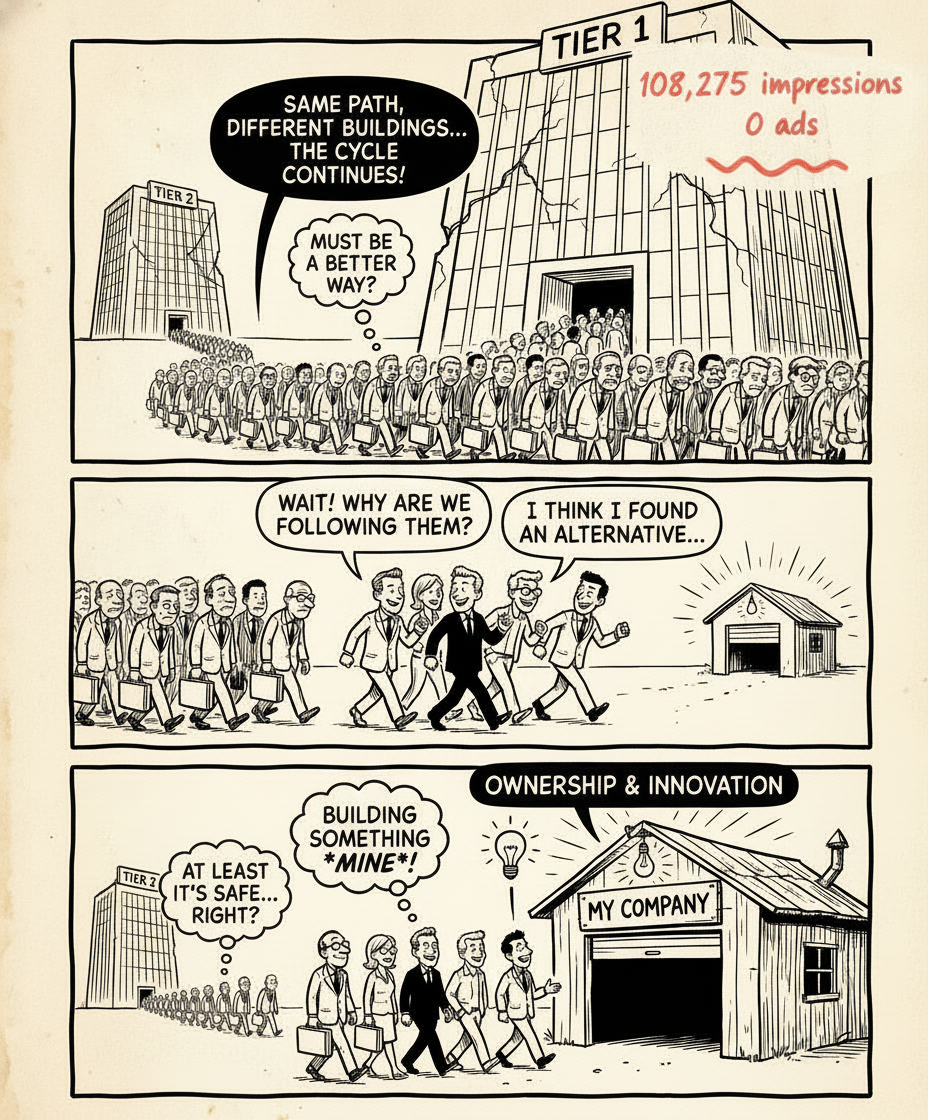
- The hook is one hard number in one direction. "87,000 senior engineers are walking out of the industry." A specific figure, a clear direction of movement, and an emotional payload in ten words. No adjective does any work — the number and the verb do all of it. Answer-engines and humans both reward this because it is unambiguously extractable and unambiguously felt.
- The structure is fact → pattern → cause → consequence. One shocking figure, then the pattern it belongs to (where the talent flows), then the deeper structural why, then what it means for the reader. That arc is what keeps a technical audience reading past the hook without a single clickbait move.
- The mechanics are named and unhedged. Real forces, real movement, no "some engineers may be considering their options." Specificity is the credibility. The people living it recognise their own team instantly, and that recognition is what makes them comment and reshare.
- The point of view is earned, not borrowed. "I spent years inside the German automotive supply chain." Insider authority beats outside analysis every time — it is the difference between commentary a VC scrolls past and commentary a hiring founder forwards to their team.
- The restraint is the multiplier. No link in the body, no CTA, no "DM me." Pure value, let recognition do the work — the funnel link lives in the first comment. A post that asks for nothing gets shared; a post that sells gets skipped.
Virality on engineering-grade content is not volume or luck. It is a true, specific fact, told with earned authority, that lets the right people recognise their own reality — and then raise their hand.
The recipe: recreate this for your industry
This is the copy-paste part. Drop these prompts into Gemini or Claude, swap in your sector, and you have the same structure working for your own pipeline. The visual step is where most people leave value on the table — do not skip it.
- Find the story. "You are an industry analyst in [my sector]. List 5 recent structural shifts insiders feel but outsiders miss — a mass exit of senior people, a skill going obsolete, a talent flow reversing, a mission moving elsewhere. For each: the hard number, the direction of movement, and why an insider would find it significant. Rank by how many people in the industry would recognise it instantly."
- Write the hook. "Turn shift #1 into a single opening line: one hard number, one direction of movement, under 12 words, zero adjectives. Give me 5 variants."
- Build the post. "Write a LinkedIn post using this arc: shocking fact → the pattern it belongs to (name where it flows) → the structural cause → what it means for [my ICP]. First person, insider POV ('I spent years in…'), named mechanics, no hedging, no CTA, no link in the body. 180–220 words."
- Make the visual value drip. "Here is a screenshot of a job board / org chart / headline that shows the shift. Using image editing, annotate it like a marked-up page: circle the key number in coral, hand-draw an arrow to the second data point, add one short margin note in my handwriting-style font. Keep it looking real and captured, not like a slick data-viz card." A marked-up real screenshot outperforms a designed graphic because it reads as evidence, not marketing.
- Place the funnel link in the first comment — never the body — with your UTM parameters, so the reach compounds into tracked pipeline instead of leaking away.
Where this sits
The way to win in a market under this much pressure is to say the true thing clearly and let the people living it raise their hands — then work the ones who do. The exodus is the human side of the same structural break I wrote about in why German auto suppliers are losing money. Turning that recognition into pipeline is the core of founder-led GTM for deep-tech. If you build or sell into the industry specifically, see GTM for automotive-software founders.
FAQ
Why are senior automotive engineers leaving the industry?
The mission, the security and the upside all moved at once. Combustion-era programs are winding down, restructuring retired the job-for-life promise, and the frontier work — autonomy, software, embedded AI — plus better pace and equity now live at software companies and startups. The most senior, most mobile people read that signal first.
Where do automotive engineers go when they leave?
Mostly to software, AI and startups, where their systems thinking transfers and the pace is higher. Controls, embedded and functional-safety engineers are ideal for robotics, autonomy, energy and defense-tech. A growing share join or found startups, where one senior engineer has far more leverage than inside a large program.
What does the automotive industry lose in the exodus?
Tacit knowledge that was never written down — the undocumented judgment about why a system is built the way it is, what breaks it, and how to pass an audit. When it walks out, programs slow and quality risk rises. That knowledge drain, not the salary line, is the real structural cost.
What should founders hiring engineers do about it?
Treat it as the best hiring window in a decade and hire for transferable rigor, not domain badges. Offer the mission, ownership and pace the car industry stopped offering, be explicit that their judgment is the asset, and move fast — the strongest ones have options the moment they signal they are open.
More on the engine behind this content: the loop — ingest, publish, mine, extract, reconcile, re-steer. One flat price, we ran it on ourselves first.