Every time a Chinese carmaker puts a new model on the road in a fraction of the time a European program takes, the reaction in Wolfsburg and Stuttgart is some version of the same sentence: "they must be cutting corners." It is the most comforting explanation available, and it is the one that keeps getting incumbents surprised. The real secret behind China Speed is not that they build worse cars faster. It is that they run a structurally different engineering and decision model — and the speed is what that structure produces.
I spent years inside the German automotive supply chain before I left to build a company, and I have watched the misread happen in real rooms. What follows is the honest version of what China Speed actually is — not a threat story, but the mechanics of it, and what it means for anyone whose revenue depends on this industry.
What people mean by "China Speed"
The number that gets quoted is a development timeline. Chinese OEMs are widely reported to take something like 18 to 24 months from concept to market, against something closer to five years for many traditional US, European and Japanese programs. That gap is real and it is startling. But the timeline is the output, not the cause. If you fixate on the number, you end up trying to compress a five-year process into two — which is exactly the wrong move, because the number is produced by a different process entirely.
Chinese OEM programs — ~18–24 months
Many traditional US / EU / JP programs — ~5 years
The gap is an output of the operating model, not the model itself.
These are the widely-cited figures that circulate whenever someone explains China Speed. Treat them as the headline symptom — the interesting question is the structure underneath, which is where the misreading lives.
Why "they're just cutting corners" is the wrong answer
The corner-cutting story survives because there is a grain of truth in it — some early Chinese products genuinely were rough. But generalising from that to "the whole thing is sloppiness" is how you talk yourself into not adapting. The speed does not come from lowering the bar. It comes from a different architecture of how work and decisions flow. Four structural choices do most of the work.
- Parallel, not gated. Western programs run in sequence through phase gates — one stage has to clear before the next begins, and a long tier-1 supplier chain sets the tempo. Chinese programs run workstreams in parallel and re-integrate constantly. Parallelisation, not haste, is where most of the calendar time disappears.
- Vertical integration. When you own more of the stack — batteries, electronics, increasingly the software — you are not waiting on a supplier's release cycle to make a decision. Fewer external gates means fewer places for the timeline to stall.
- Software-first architecture. Designing the vehicle around software from the start means a car does not have to be finished at launch to be good. It can ship and keep improving over the air, which changes what "done" even means.
- Tolerance for iteration. The organisation is built to ship, learn and revise rather than to eliminate every risk before launch. That is a cultural and structural stance, and it is the one Western process is least equipped to copy.
China Speed is not a shortcut through the same process. It is a different process — one that treats a launched product as the start of the work, not the end of it.
Why Western OEMs can't just copy it
Once you see the speed as an output of structure, the obvious question answers itself: why not simply adopt the structure? Because the structure is the hard part, and it is entangled with everything else about how a traditional OEM works. Gated development, a deep tier-1 supplier chain, combustion-era process, and an organisation carefully optimised over decades not to make mistakes — those are not toggles. Parallel development, vertical integration and a software-first stack change who decides, how fast, and where the risk sits. You cannot buy the timeline without rebuilding the operating model that produces it, and that is a multi-year, politically painful transformation, not a program-management tweak.
This is why the honest commentary on China Speed lands so hard with people inside the industry: it names the thing the incumbent org is structurally unable to just decide its way out of. Recognition, not novelty, is what makes an insider stop scrolling.
The part almost nobody prices in: the cost of doing it by hand
There is a quieter driver underneath all four choices, and it is the one I know best. The traditional model was built on people — thousands of them, hand-building requirements, hand-tracing code to architecture, hand-assembling the compliance evidence that a program like ASPICE demands, one gate at a time. That serial, manual approach is precisely what makes a five-year timeline feel unavoidable. When your engineering and compliance work is human-hours-in-sequence, you cannot parallelise your way to China Speed, because the humans are the bottleneck. Closing the gap is not only about strategy; it is about automating the manual engineering and compliance work that assumed human hours were cheap and infinite — the same pressure now breaking the tier-1 supplier model from the cost side.
What China Speed means for anyone selling into automotive
If your revenue touches this industry — tools, software, services, talent — China Speed is not a geopolitics headline. It resets the clock everyone in the supply chain is measured against.
- Speed becomes the buying criterion. Buyers are now under pressure to compress their own timelines. A vendor that adds another gated step loses; a vendor that helps them parallelise and move faster wins. Reposition around velocity or get cut.
- Cost-out and automation over headcount. The manual, serial way of doing engineering and compliance is the thing under scrutiny. Provable automation of that work is what a buyer under this pressure will actually pay for.
- Proof beats pitch. Buyers racing the clock discount claims and reward evidence. "We compressed X on a real engagement, here is the number" outperforms any feature list.
This is also why the founders and operators who win attention in this market are the ones naming the structural truth out loud instead of selling around it. The most-read commentary on China Speed was not analysis from the outside — it was pattern recognition from someone who had sat inside the machinery. That is a positioning lesson as much as an industry one.
Selling into a market that's racing the clock?
The buyers who feel this pressure are already in your LinkedIn engagement — reacting to the posts that name their reality. See where you stand — a free, personalized LinkedIn visibility audit + blueprint in your inbox within 48 hours. No card, no call.
Book a call →Why this post landed — the anatomy
The explainer above started as a single LinkedIn post: "The real secret behind 'China Speed'." It did not chase reach and it did not reach-hack. It drew the response it did — comments and reshares from people who work in the industry — because it named a mechanism the audience recognised in their own work. It followed a repeatable structure that any technical founder can copy to build pipeline and credibility with founders, suppliers and OEMs. Here is the teardown.
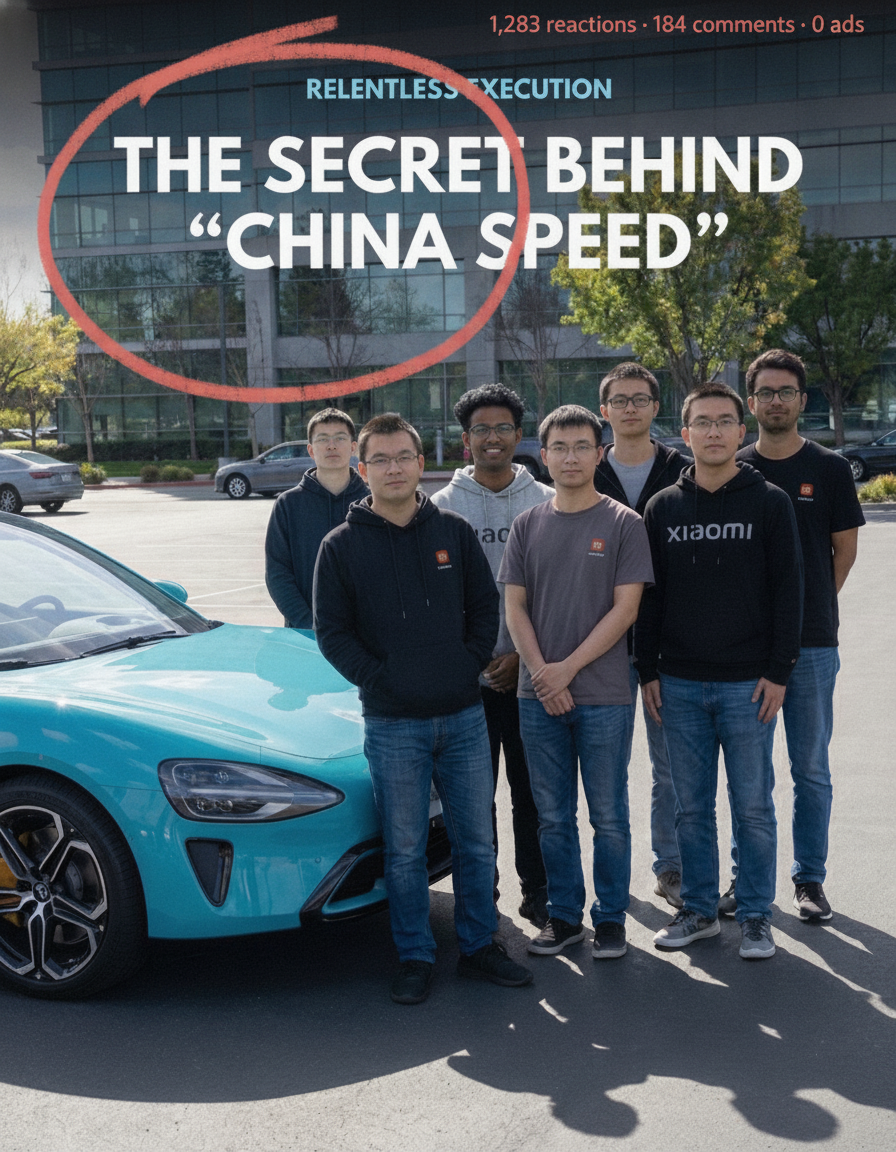
- The hook names a shared misread. "The real secret behind China Speed" works because everyone in the industry has heard the lazy explanation — cutting corners — and half-suspects it is wrong. Promising the real mechanism to an expert audience is a stronger hook than any number, because it offers them a correction to something they already argue about.
- The structure is misread → real cause → consequence. State the comforting wrong answer, replace it with the structural one, then follow the consequences out to the reader. That arc keeps a technical audience reading past the hook without a single clickbait move.
- The mechanism is named and unhedged. Parallel development, vertical integration, software-first, tolerance for iteration — concrete, nameable structure, not "China moves differently." Specificity is the credibility. The people living it recognise each mechanism instantly, and that recognition is what makes them comment.
- The point of view is earned, not borrowed. "I spent years inside the German automotive supply chain." Insider authority beats outside analysis every time — it is the difference between a take a VC scrolls past and one an OEM engineer forwards to their team.
- The restraint is the multiplier. No link in the body, no CTA, no "DM me." Pure value, let recognition do the work — the funnel link lives in the first comment. A post that asks for nothing gets shared; a post that sells gets skipped.
Resonance on engineering-grade content is not volume or luck. It is a true, specific mechanism, told with earned authority, that lets the right people recognise their own reality — and then raise their hand.
The recipe: recreate this for your industry
This is the copy-paste part. Drop these prompts into Gemini or Claude, swap in your sector, and you have the same structure working for your own pipeline. The visual step is where most people leave value on the table — do not skip it.
- Find the misread. "You are an industry analyst in [my sector]. List 5 terms or trends that everyone in the industry names but most people explain wrong — where the lazy explanation and the real mechanism diverge. For each: the common misread, the real structural cause, and why an insider would recognise the gap instantly. Rank by how widely the term is used."
- Write the hook. "Turn misread #1 into a single opening line: name the common wrong explanation and promise the real mechanism, under 12 words, zero adjectives. Give me 5 variants."
- Build the post. "Write a LinkedIn post using this arc: the common misread → the real structural cause (name 3–4 concrete mechanisms) → the second-order consequences → what it means for [my ICP]. First person, insider POV ('I spent years in…'), named mechanisms, no hedging, no CTA, no link in the body. 180–220 words."
- Make the visual value drip. "Draw the two operating models side by side as a hand-drawn whiteboard sketch: on the left, gated/sequential development with phase gates; on the right, parallel workstreams re-integrating. Coral highlights on the key difference, one short margin note in my handwriting-style font. Keep it looking captured and real, not like a slick data-viz card." A hand-drawn model diagram outperforms a designed graphic because it reads as thinking, not marketing.
- Place the funnel link in the first comment — never the body — with your UTM parameters, so the reach compounds into tracked pipeline instead of leaking away.
Where this sits
China Speed is really a story about software eating the vehicle and the timeline with it — which is the same shift I break down in the software-defined vehicle reality check. The way to win in a market moving this fast is to say the true thing clearly and let the people living it raise their hands — the core of founder-led GTM for deep-tech — and the mechanics of turning that recognition into pipeline are in turning LinkedIn engagement into B2B pipeline. If you sell into the industry specifically, see GTM for automotive-software founders.
FAQ
What is China Speed in the automotive industry?
The term for how fast Chinese carmakers get a model from concept to market — widely cited as ~18–24 months versus ~5 years for many traditional programs. But the speed is an output of a different operating model: parallel development, vertical integration, software-first architecture and a tolerance for iteration.
Is China Speed just corner-cutting?
Mostly no. Some early products were rough, but the speed comes from running workstreams in parallel, owning more of the stack, and designing around software — a different engineering model, not a lower standard. Assuming it is sloppiness is how incumbents keep getting surprised.
Why can't Western OEMs just copy it?
Because the speed comes from structure, and structure is hard to retrofit. Gated development, a deep supplier chain and a mistake-averse org do not toggle into parallel, vertically integrated, software-first ones. You cannot buy the timeline without rebuilding the operating model behind it.
What does it mean for companies selling into automotive?
Speed becomes the buying criterion. Buyers must compress their own timelines and take manual effort out of engineering and compliance. Sell velocity, parallelisation and provable outcome — not incremental features — or get cut.
More on the engine behind this content: the loop — ingest, publish, mine, extract, reconcile, re-steer. One flat price, we ran it on ourselves first.