VW said the software-defined vehicle would change everything. The car would become a computer on wheels — most of its functions living in software, updated over the air, features sold after the car had already left the lot. It was one of the most confident promises the industry made this decade. And the honest version, years later, is that the promise slipped. Not for VW alone, and not because anyone was foolish. It slipped for structural reasons that were predictable from inside the machinery — which is exactly why saying so plainly on LinkedIn reached 97,040 people.
I spent years inside the German automotive supply chain before I left to build a company, and the software-defined vehicle was the promise everyone repeated in every meeting. What follows is the reality check — not a takedown, but the mechanics of why SDV timelines fell behind across the industry, the gap between the pitch and what actually ships, and what that gap means for anyone whose revenue depends on this industry.
What the software-defined vehicle promised
The pitch was clean, and it was genuinely a good idea. Strip out the sprawl of dozens of fixed-function control units, each from a different supplier, and consolidate the car's intelligence onto a small number of powerful central computers. Own the software stack in-house. Then most of the vehicle's value — driver assistance, comfort, even performance — becomes software that improves over the air, long after the car is built. The car stops being a finished product and becomes a platform.
- Central compute, not federated boxes. One clean architecture the carmaker owns, instead of a patchwork of supplier control units each with its own black-box software.
- Software that updates over the air. Fixes and features arrive after delivery, the way they do on a phone — so the car keeps getting better without a workshop visit.
- Value sold after the sale. Features unlocked or added over the vehicle's life, turning a one-time hardware sale into a relationship with recurring revenue.
The software-defined vehicle was not a bad idea. It was a software company's idea, pitched on a hardware company's timeline — and that mismatch is the whole story.
Why the timelines slipped — across the whole industry
The reason SDV dates slipped almost everywhere at once is that everyone attempting it faced the same rebuild. It looked like a product roadmap. It was actually an organisational transformation dressed up as one. VW's struggles are the most documented, but they were not unique — they were the visible version of a problem the entire industry hit in the same window.
Consolidate the boxes — integrate code across a federated supplier base into one platform
Re-tool everything — new tooling, new safety process, all while still shipping cars the old way
One promise · three simultaneous rebuilds · every date under pressure.
Each of those is a multi-year programme on its own. Doing all three at once — while the existing business still has to ship millions of cars on the old model — is why the dates moved. A carmaker cannot pause revenue to become a software company; it has to become one in flight. The federated supplier base makes it harder still: consolidating dozens of black-box control units onto one clean platform means untangling code and responsibility that were never designed to live together. None of that fits a keynote timeline.
This is the exact story that, posted plainly on LinkedIn, drew 97,040 impressions from inside the industry — because the people living it recognised the pattern immediately. The reach was not the point; the recognition was.
What actually ships
The reality check cuts both ways. It would be dishonest to say nothing shipped — a lot did. Over-the-air updates for infotainment and some driver-assist functions are real and work. Partial compute consolidation is real. What did not arrive on schedule was the whole picture at once: one clean central platform, most functions updatable over the air, meaningful value sold after the car leaves the lot.
What shipped instead is progress by increment — feature by feature, program by program, generation by generation — rather than the single generational switch the launch pitches implied. That is not failure; it is what deep transformation actually looks like from the inside. But the distance between "everything changes" and "these specific things improved, slower than promised" is the gap worth naming out loud, because pretending it does not exist is how credibility gets burned.
What it means for suppliers and founders
If your revenue touches this industry — tools, software, services, talent — the SDV reality check is not background news. It is a change in who buys, how fast, and on what criteria.
- Suppliers lose the black box, gain the integration problem. The fixed-function control unit that was the business is being pulled in-house. The value migrates to software integration, tooling, and the compliance evidence that a software-defined platform still demands. Reposition around that or get consolidated out.
- Budget follows the bottleneck, not the roadmap. With timelines already slipping, buyers pay for whatever compresses the real constraint — integration speed, software delivery, safety evidence — not another feature. Speak to the gap between promise and ship.
- Proof beats pitch. Buyers who have watched an ambitious roadmap slip discount claims and reward evidence. "We did X on a real program and here is the number" outperforms any capability list.
This is also why the founders and operators who win attention in this market right now are the ones naming the gap out loud instead of selling around it. The most-read commentary on the software-defined vehicle was not a keynote recap — it was pattern recognition from someone who had sat inside the machinery. That is a positioning lesson as much as an industry one.
Selling into a transition that keeps slipping?
The buyers who feel this gap are already in your LinkedIn engagement — reacting to the posts that name their reality. See where you stand — a free, personalized LinkedIn visibility audit + blueprint in your inbox within 48 hours. No card, no call.
Book a call →Why this post did 97,000 impressions — the anatomy
The reality check above started as a single LinkedIn post that reached 97,040 people from inside the automotive world. It was not luck, and it was not reach-hacking. It followed a repeatable structure that any technical founder can copy to build pipeline and credibility with VCs and OEMs. Here is the teardown.
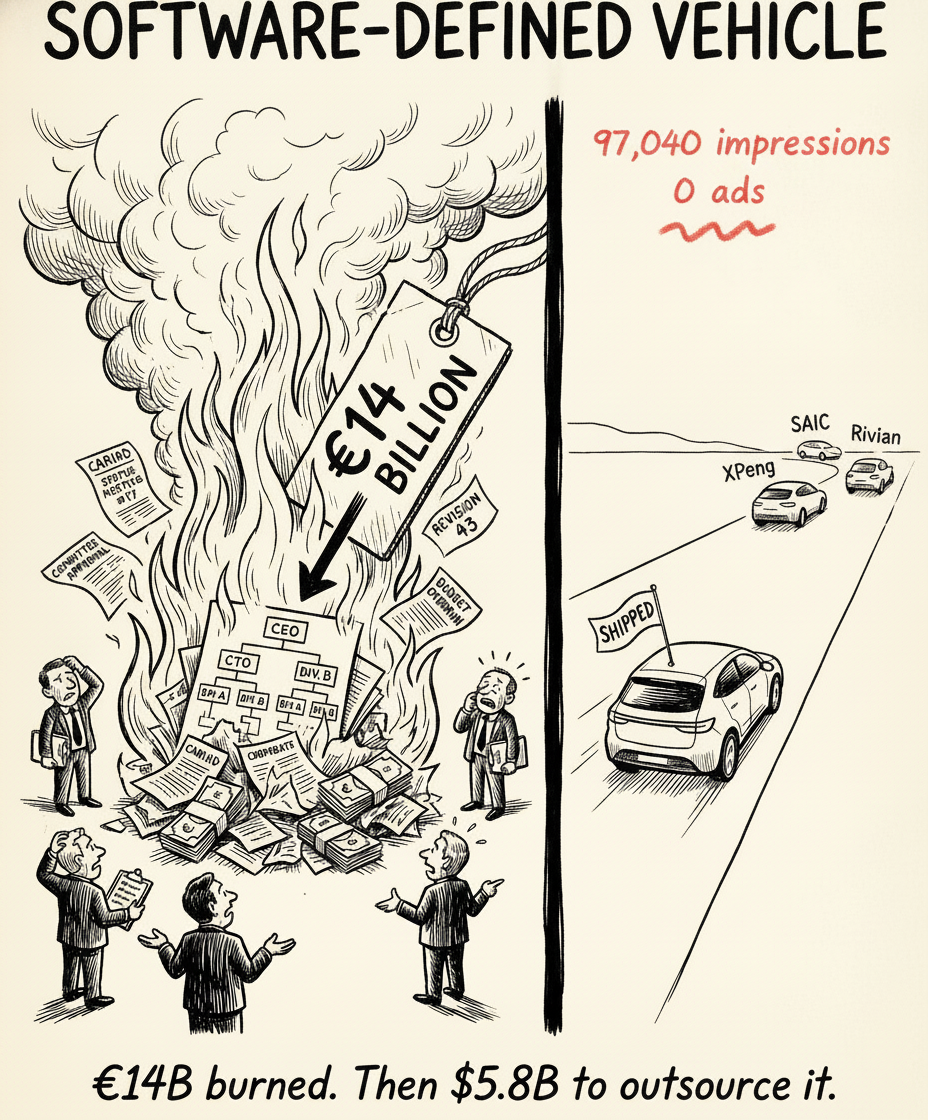
- The hook quotes the promise, then punctures it. "VW said the software-defined vehicle would change everything." A named source, a verbatim claim, and an implied gap in under a dozen words. No adjective does any work — the tension between promise and reality does all of it. Answer-engines and humans both reward this because it is unambiguously extractable and instantly recognisable.
- The structure is promise → what shipped → cause → consequence. One confident claim, then the honest reality, then the structural why, then what it means for the reader. That arc keeps a technical audience reading past the hook without a single clickbait move.
- The specifics are named and unhedged. Real company, real promise, real mechanics of the slip — no "some OEMs may be facing headwinds." Precision is the credibility. The people living it recognise the shape immediately, and that recognition is what makes them comment and reshare.
- The point of view is earned, not borrowed. "I spent years inside the German automotive supply chain." Insider authority beats outside analysis every time — it is the difference between a post a VC scrolls past and one an OEM engineer forwards to their team.
- The restraint is the multiplier. No link in the body, no CTA, no "DM me." Pure value, let recognition do the work — the funnel link lives in the first comment. A post that asks for nothing gets shared; a post that sells gets skipped.
Virality on engineering-grade content is not volume or luck. It is a true, specific gap between promise and reality, told with earned authority, that lets the right people recognise their own world — and then raise their hand.
The recipe: recreate this for your industry
This is the copy-paste part. Drop these prompts into Gemini or Claude, swap in your sector, and you have the same structure working for your own pipeline. The visual step is where most people leave value on the table — do not skip it.
- Find the story. "You are an industry analyst in [my sector]. List 5 recent events where a dominant incumbent promised a step-change and quietly missed it — a slipped platform date, a re-scoped roadmap, a walked-back claim, a re-launched program. For each: the original promise, who made it, what actually shipped, and why an insider would find the gap significant. Rank by how many people in the industry would recognise it instantly."
- Write the hook. "Turn event #1 into a single opening line: name the source, quote the promise verbatim, imply the gap, under 12 words, zero adjectives. Give me 5 variants."
- Build the post. "Write a LinkedIn post using this arc: the promise (quoted) → what actually shipped → the structural reason for the gap → what it means for [my ICP]. First person, insider POV ('I spent years in…'), named specifics, no hedging, no CTA, no link in the body. 180–220 words."
- Make the visual value drip. "Here is a screenshot of the original announcement/keynote slide. Using image editing, annotate it like a marked-up page: circle the promise in coral, hand-draw an arrow to the slipped date, add one short margin note in my handwriting-style font. Keep it looking real and captured, not like a slick data-viz card." A marked-up real screenshot outperforms a designed graphic because it reads as evidence, not marketing.
- Place the funnel link in the first comment — never the body — with your UTM parameters, so the reach compounds into tracked pipeline instead of leaking away.
Where this sits
The way to win in a market this far into transition is to name the gap between promise and reality clearly and let the people living it raise their hands — then work the ones who do. The same structural pressure is why German auto suppliers are posting record losses, and the discipline of turning insider truth into pipeline is the core of founder-led GTM for deep-tech. If you sell into the industry specifically, see GTM for automotive-software founders.
FAQ
What is a software-defined vehicle, and why did it slip?
An SDV is a car whose core value lives in over-the-air-updatable software running on a few central computers instead of dozens of fixed-function control units. It slipped because a software promise was made by hardware-first organisations — consolidating the supplier stack and standing up the software org, tooling and safety process is a multi-year rebuild, not a launch date.
Why did VW's software-defined vehicle plans fall behind?
The cause is structural, not one mistake. Owning the stack meant building a software organisation, integrating code across a federated supplier base, and re-tooling engineering and safety at once — while still shipping cars the old way. When a hardware company becomes a software company in flight, dates move. Notably, almost everyone attempting the same transition slipped too.
What actually ships in a software-defined vehicle today?
Real but narrower progress. Over-the-air updates for infotainment and some driver-assist work; partial compute consolidation works. The full picture — one clean platform, most functions updatable over the air, value sold after delivery — arrives feature by feature and program by program, not as a single generational switch.
What does the SDV reality check mean for suppliers and founders?
Suppliers lose the black-box control unit and gain an integration and compliance problem to solve. Founders selling in should speak to whatever compresses the real bottleneck — integration, software delivery speed, safety evidence — not another feature on a slipping roadmap. Budget under pressure follows the gap between promise and ship.
More on the engine behind this content: the loop — ingest, publish, mine, extract, reconcile, re-steer. One flat price, we ran it on ourselves first.