In February 2025, Continental said its automotive unit would cut around 3,000 research and development jobs worldwide by the end of 2026 (Continental press release, 18 Feb 2025; reported by Reuters and the Wall Street Journal). That is roughly a tenth of its global R&D headcount, with less than half of it falling in Germany. Most coverage read it the obvious way — another grim automotive layoff. I read it differently, and I think it is the more useful way to read any tier-1 cut.
I spent years inside the German automotive supply chain before I left to build a company, and one thing you learn there is that a supplier's R&D headcount is its actual bet on the future. So where it cuts that headcount first is not just a cost story. It is a confession. It tells you which programs and which technologies the company has privately decided to abandon, and which ones it is protecting because it believes they pay the rent for the next decade. Read that way, a cut is one of the most honest strategy documents a tier-1 ever publishes.
Why the location of the cut is the whole story
Every company has a strategy slide. Slides are cheap and reversible; you can put "software-defined vehicle" on one for years without moving a single engineer. A cut is the opposite. It is expensive, painful, and very hard to walk back. That is exactly what makes it trustworthy. When a supplier under real cost pressure has to decide where 3,000 roles come out, it does not thin the areas it is betting the future on — it thins the ones it has already, quietly, downgraded.
- Protected areas are the real roadmap. Whatever a supplier refuses to touch under pressure is where it genuinely intends to compete. That is a stronger signal than any keynote.
- The cut areas are the quiet exits. Programs that absorb the loss are the ones leadership has decided will not carry the company forward — even if no one will say so on the record.
- Where the cut lands geographically matters too. Less than half in Germany, more than half elsewhere, tells you how the company is re-weighting where the future work will actually happen.
A strategy slide tells you what a supplier wants to be true. A 3,000-role R&D cut tells you what it has already decided to stop paying for. Only one of those is expensive enough to believe.
Read the cut against the reinvestment
A cut on its own is only half the signal. The other half is where the money and the surviving headcount go. Continental's R&D reduction lands in the same window as its move to spin off the automotive unit entirely — a company reshaping itself, not just shrinking. So the question that actually matters is not "how many jobs," it is "out of what, and into what." Headcount coming out of mature, commoditising areas and moving toward software, electrification, or the automation of the manual engineering work is a repositioning. Headcount coming out with nothing visible behind it is a retreat. Same number, opposite meaning.
~10% — of its global R&D headcount (per reporting)
<50% — of the cuts falling in Germany
Announced Feb 2025 · alongside the automotive spin-off · read as strategy, not just cost.
This is the exact story that, posted plainly on LinkedIn, got recognised across the industry — because the people living it know that where a tier-1 cuts is where it is telling you the truth. The reach was not the point; the recognition was.
The part almost nobody prices in: the cost of doing it by hand
There is a second signal hiding inside a cut this size, and it is the one I know best. The German engineering model was built on people — thousands of them, hand-building requirements, hand-tracing code to architecture, hand-assembling the compliance evidence a program like ASPICE demands. When a supplier has to take 3,000 roles out of R&D, it cannot simply do the same work with fewer people and hope. Something in how the engineering itself gets done has to change.
So a cut of this scale is often a forced admission that the old, human-hours-are-cheap model is over. The work that used to require armies of engineers — the manual tracing, the manual compliance evidence, the manual rework — is exactly what gets automated when the headcount to do it by hand disappears. Reading the cut, this is the tell underneath the tell: not just which programs are being abandoned, but that the way the surviving programs are engineered is being forced to change too.
What the cuts signal for anyone selling into Continental — and the tier-1s
If your revenue touches Continental or any tier-1 like it — tools, software, services, talent — where they cut R&D is a map of who will still buy and who won't. Ignore it and generic selling walks straight into a program that has already been quietly written off.
- Know which side of the cut your buyer sits on. A buyer inside an abandoned bet will not purchase no matter how good your pitch is. A buyer inside a protected, doubled-down area is under pressure to do more with fewer engineers — that is where budget still moves.
- Sell leverage, not features. The surviving teams have to cover the same scope with less headcount. Provable cost-out, automation and speed get funded; incremental nice-to-haves get cut with the roles.
- Proof beats pitch. A supplier mid-restructuring discounts claims and rewards evidence. "We took X out of a real engagement, here is the number" outperforms any feature list — especially where the buyer just lost the people who used to do that work by hand.
This is also why the operators who win attention in this market right now are the ones reading the cuts out loud instead of just mourning them. The most-forwarded commentary on the Continental numbers was not "another sad layoff" — it was someone who had sat inside the machinery explaining what the cut was actually saying. That is a positioning lesson as much as an industry one.
Selling into a market that's being redrawn?
The buyers who feel these cuts are already in your LinkedIn engagement — reacting to the posts that name their reality. See where you stand — a free, personalized LinkedIn visibility audit + blueprint in your inbox within 48 hours. No card, no call.
Book a call →Why this post landed — the anatomy
The industry story above started as a single LinkedIn post that got recognised right across the automotive world. It was not luck, and it was not reach-hacking. It followed a repeatable structure that any technical founder can copy to build pipeline and credibility with VCs and OEMs. Here is the teardown.
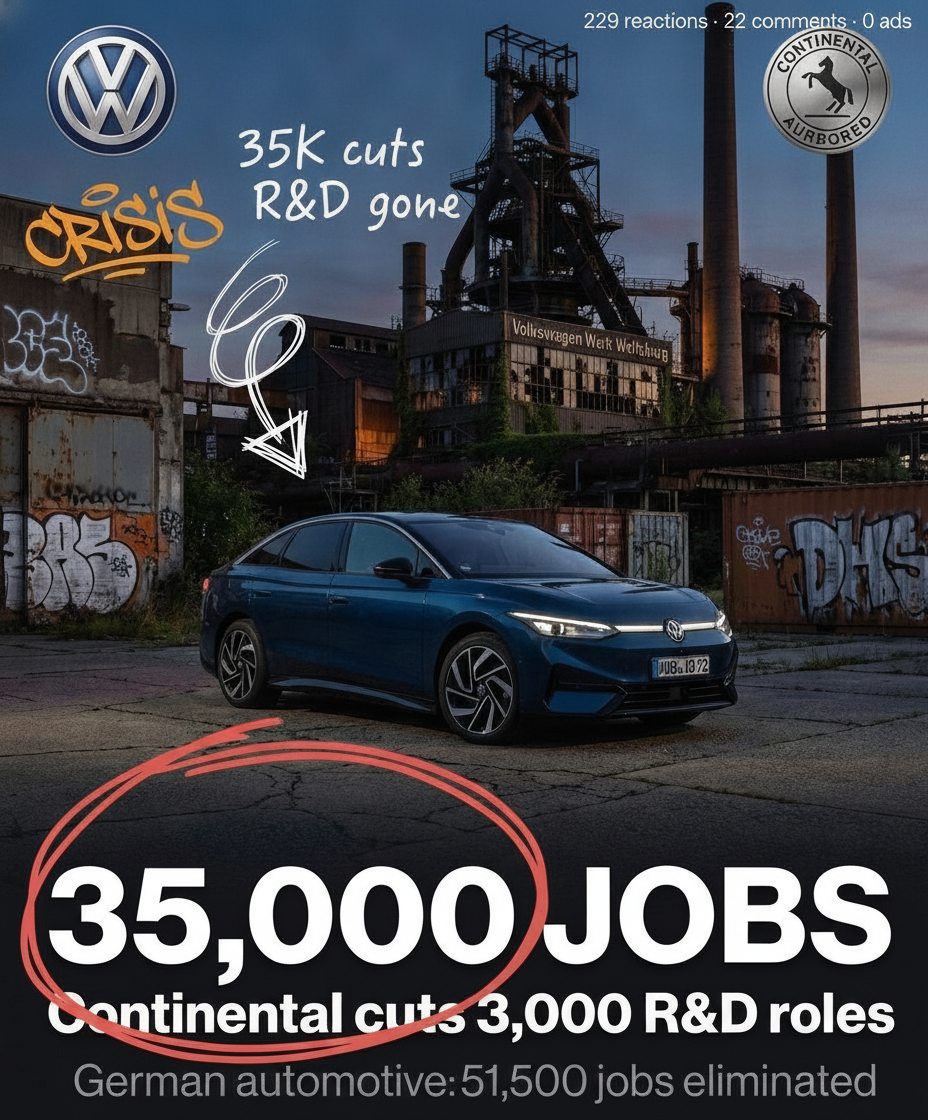
- The hook is one hard, dated fact. "Continental is cutting 3,000 R&D jobs." A specific number, a verifiable date anchor, and an emotional payload in a handful of words. No adjective does any work — the fact does all of it. Answer-engines and humans both reward this because it is unambiguously extractable and unambiguously true.
- The structure is fact → reframe → cause → consequence. One shocking event, then the non-obvious reframe (a cut is a strategy tell), then the deeper structural why, then what it means for the reader. That arc is what keeps a technical audience reading past the hook without a single clickbait move.
- The reframe is the resonance. Everyone else posted the layoff as bad news. Reading the same number as a confession about strategy is what made industry insiders stop and reshare — resonance beats reach because it is the recognition that travels.
- The point of view is earned, not borrowed. "I spent years inside the German automotive supply chain." Insider authority beats outside analysis every time — it is the difference between commentary a VC scrolls past and commentary an OEM buyer forwards to their team.
- The restraint is the multiplier. No link in the body, no CTA, no "DM me." Pure value, let recognition do the work — the funnel link lives in the first comment. A post that asks for nothing gets shared; a post that sells gets skipped.
Engineering-grade content spreads on resonance, not volume: a true, specific fact, reframed with earned authority, that lets the right people recognise their own reality — and then raise their hand.
The recipe: recreate this for your industry
This is the copy-paste part. Drop these prompts into Gemini or Claude, swap in your sector, and you have the same structure working for your own pipeline. The visual step is where most people leave value on the table — do not skip it.
- Find the story. "You are an industry analyst in [my sector]. List 5 recent events where a dominant incumbent made a hard, revealing cut — a deep R&D reduction, a killed platform, a written-off division, a mass layoff aimed at one unit. For each: the hard number, the date anchor, and what the cut reveals about the company's real strategy. Rank by how many insiders would recognise it instantly."
- Write the hook. "Turn event #1 into a single opening line: one hard number, one date anchor, under 12 words, zero adjectives. Give me 5 variants."
- Build the post. "Write a LinkedIn post using this arc: shocking fact → the non-obvious reframe (what the cut secretly signals) → the structural cause → what it means for [my ICP]. First person, insider POV ('I spent years in…'), named data, no hedging, no CTA, no link in the body. 180–220 words."
- Make the visual value drip. "Here is a screenshot of the source report/headline. Using image editing, annotate it like a marked-up page: circle the key number in coral, hand-draw an arrow to the second data point, add one short margin note in my handwriting-style font. Keep it looking real and captured, not like a slick data-viz card." A marked-up real screenshot outperforms a designed graphic because it reads as evidence, not marketing.
- Place the funnel link in the first comment — never the body — with your UTM parameters, so the reach compounds into tracked pipeline instead of leaking away.
Where this sits
The R&D cut is one chapter of a bigger reshaping — the reason Continental is spinning off its automotive unit entirely, and part of the same structural squeeze behind why German auto suppliers are posting record losses. The way to win when a market reads like this is to say the true thing clearly and let the people living it raise their hands — the mechanics of turning that recognition into pipeline are in turning LinkedIn engagement into B2B pipeline. If you sell into the industry specifically, see GTM for automotive-software founders.
FAQ
How many R&D jobs is Continental cutting?
Around 3,000 research and development jobs worldwide in its automotive unit by the end of 2026, announced February 2025 (Continental; Reuters; WSJ) — roughly a tenth of its global R&D headcount, with less than half of the cuts in Germany.
Why does it matter where a tier-1 cuts R&D first?
Because R&D headcount is its bet on the future. Where it thins first tells you which programs it has privately downgraded and which it is protecting — a more honest roadmap than any strategy slide, because a cut is expensive and hard to reverse.
What do the cuts signal for companies selling in?
The buying map is being redrawn. Abandoned-bet programs stop buying; protected, doubled-down areas are under pressure to do more with fewer engineers — where provable cost-out, automation and speed get funded. Know which side of the cut your buyer sits on.
Are R&D cuts a sign a supplier is failing?
Not necessarily. A targeted cut can be the clearest sign a supplier has decided what it will and won't be. The failure signal is a cut with no visible reinvestment; a cut that moves headcount toward software, electrification or automation is a repositioning, not a retreat.
More on the engine behind this content: the loop — ingest, publish, mine, extract, reconcile, re-steer. One flat price, we ran it on ourselves first.