In May 2026, Ferrari unveiled its first electric car, the Luce, in Rome. The story that stopped me was not the teardrop glasshouse or the 122-kilowatt-hour battery. It was who shaped it. The Luce was designed in collaboration with LoveFrom — the studio founded by Jony Ive and Marc Newson. Jony Ive is the designer most associated with the iPhone. So, put bluntly: Ferrari hired a phone designer to design a Ferrari.
I spent years inside the automotive world before I left to build a company, and I read that move the way an insider reads a tell in a poker game. It is not a curiosity. It is Ferrari saying out loud where it thinks the value of a car now lives — and if you sell into this industry, or build in it, that sentence should change how you think about your next few years.
Why "Ferrari hired a phone designer" is the whole story
For a century, the magic of a Ferrari lived in the mechanical layer. The engine, the exhaust note, the way the drivetrain delivered power — that was the product, and everything else served it. The design tradition that grew up around that was coachbuilding: sculpting metal around a machine whose character came from combustion. Reaching past that tradition, all the way to the person who defined modern consumer-hardware design, is not a styling choice. It is a statement about what the differentiator has become.
- The mechanical layer is being commoditised. In an EV, the powertrain is largely a bought-in stack of cells, inverters and motors. The thing that used to carry a Ferrari's identity — the engine — is precisely the thing electrification flattens.
- The differentiation moves to surfaces, interface and experience. With no engine to design around, what remains to obsess over is the glasshouse, the surfaces, the cabin, the interface, the felt quality of every interaction — exactly the vocabulary a consumer-hardware designer speaks natively.
- The hire makes the shift visible. Ferrari did not write a press release announcing a new strategy. It announced it by who it chose to hold the pen. That is a louder signal than any slide.
When the most protective brand in the mechanical world reaches for the designer of the iPhone, it is telling you the mechanical layer is no longer where the differentiation lives.
What the design language actually signals
The importance is not that a Ferrari now looks a little more like an Apple product. It is what that borrowing represents. Consumer-hardware design is a discipline built around interface, software and the total experience of using an object — the layers that got commoditised late, if at all, in phones and computers. When that language moves into the car, it drags the center of gravity with it. The parts of the vehicle that were once supporting cast — the screen, the sensing, the software, the way it feels to sit in and operate — become the lead.
This is the same migration that reshaped every hardware category consumer electronics touched. The hardware became a commodity substrate; the differentiation, the margin and the loyalty moved into software and experience. A Ferrari built with LoveFrom is that pattern arriving in the one category that resisted it longest, because its mechanical soul was the whole point. If it is happening here, it is happening everywhere in the car.
What this means for automotive suppliers
If your business is built on the mechanical layer of the car, this shift is not abstract. It is a question about where your revenue sits five years out. When the differentiator moves from the parts you make to the software and experience layers you may not own, value and budget move with it — away from you.
New differentiator — interface, software, sensing, felt experience
The tell — Ferrari's first EV designed with the iPhone's designer
Value migrates up the stack · budget follows the differentiator · mechanical-only is exposed.
Posted plainly on LinkedIn, the "Ferrari hired a phone designer" observation resonated hard inside the industry — because the people living the shift recognised the tell immediately. The reach was not the point; the recognition was.
The quieter driver: who owns the experience layer
There is a second, less obvious consequence, and it is the one I watch most closely. When differentiation lives in software and experience, the supply chain re-sorts around who can build and integrate that layer, and how fast. The old model — deep mechanical expertise, thousands of engineers hand-building and hand-tracing hardware — does not automatically extend into a world where the prized skill is designing an interface, integrating a software stack, and shipping a felt experience at pace.
That is the real restructuring underneath the surface story. Not just new styling, but a change in which capabilities carry the margin. A supplier that cannot move up toward the software, sensing and experience layers — or partner its way there credibly — is holding the part of the car that is becoming the commodity substrate. The Ferrari–LoveFrom collaboration is the loudest possible signpost that the map has been redrawn.
Selling into a market whose differentiators are moving?
The buyers who feel this shift are already in your LinkedIn engagement — reacting to the posts that name their reality. See where you stand — a free, personalized LinkedIn visibility audit + blueprint in your inbox within 48 hours. No card, no call.
Book a call →Why this post landed — the anatomy
The observation above started as a single LinkedIn post — "Ferrari hired a phone designer" — and it resonated far inside the automotive world. It was not luck, and it was not reach-hacking. It followed a repeatable structure that any technical founder can copy to build pipeline and credibility with VCs and OEMs. Here is the teardown.
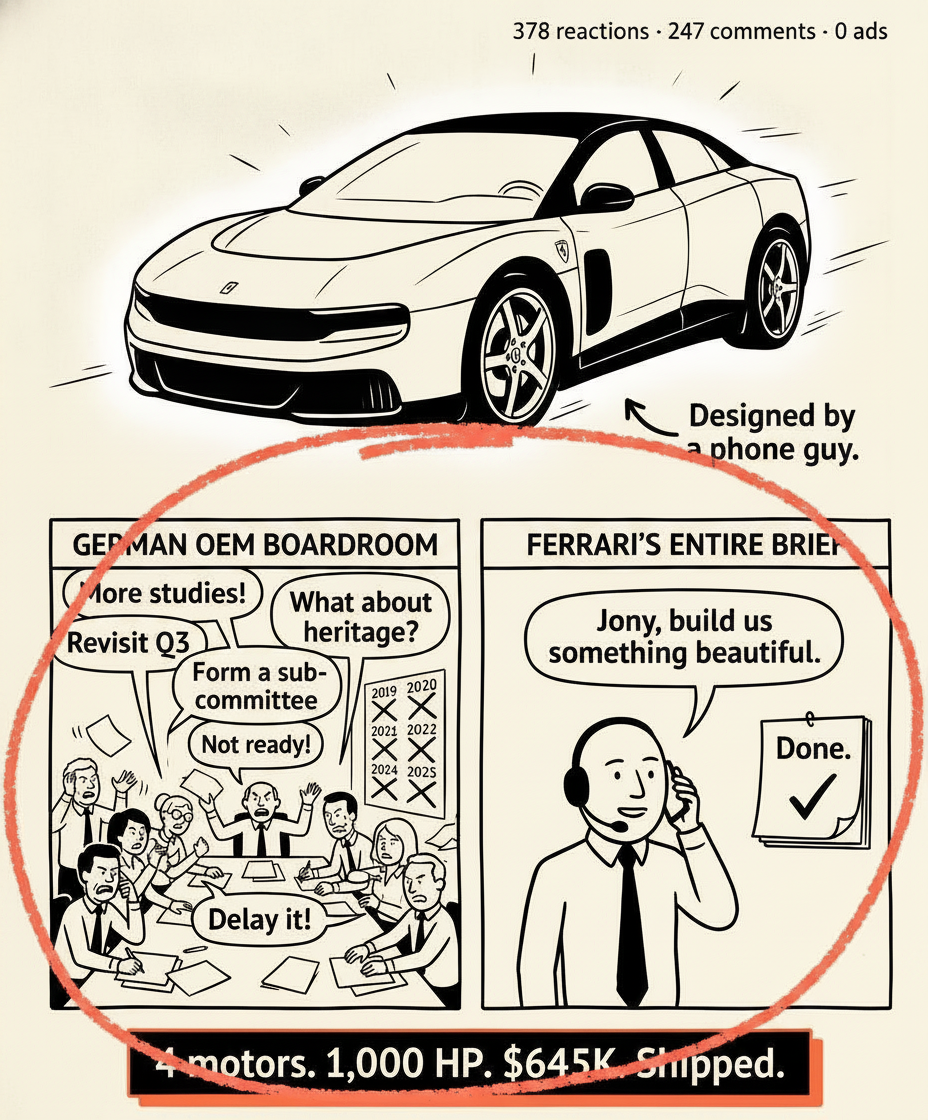
- The hook is one concrete, slightly disorienting fact. "Ferrari hired a phone designer." Five words that collide two worlds that are not supposed to touch. It is true, it is specific, and the collision does the emotional work — no adjective required. Answer-engines and humans both reward a claim that is unambiguously extractable and unambiguously true.
- The structure is fact → pattern → cause → consequence. One disorienting move, then the pattern it belongs to (consumer-hardware design eating category after category), then the structural why (mechanical differentiation being commoditised), then what it means for the reader. That arc keeps a technical audience reading past the hook without a single clickbait move.
- The specifics are named and unhedged. Ferrari, the Luce, LoveFrom, Jony Ive, the iPhone. No "some luxury brands are exploring new design partners." Precision is the credibility — the people living it recognise the names instantly, and that recognition is what makes them comment and reshare.
- The point of view is earned, not borrowed. "I spent years inside the automotive world." Insider authority beats outside punditry every time — it is the difference between commentary a VC scrolls past and commentary an OEM buyer forwards to their team.
- The restraint is the multiplier. No link in the body, no CTA, no "DM me." Pure observation, let recognition do the work — the funnel link lives in the first comment. A post that asks for nothing gets shared; a post that sells gets skipped.
Resonance on engineering-grade content is not volume or luck. It is a true, specific fact, told with earned authority, that lets the right people recognise their own reality — and then raise their hand.
The recipe: recreate this for your industry
This is the copy-paste part. Drop these prompts into Gemini or Claude, swap in your sector, and you have the same structure working for your own pipeline. The visual step is where most people leave value on the table — do not skip it.
- Find the signal. "You are an industry analyst in [my sector]. List 5 recent moves where an incumbent did something that quietly announces a shift — an unexpected hire, a category-crossing partner, a first-ever product, a walk-away from tradition. For each: the concrete fact, the date anchor, and why an insider would read it as a tell. Rank by how many people in the industry would recognise it instantly."
- Write the hook. "Turn move #1 into a single opening line: one concrete, slightly disorienting fact, under 12 words, zero adjectives — the kind that makes an insider stop scrolling. Give me 5 variants."
- Build the post. "Write a LinkedIn post using this arc: disorienting fact → the pattern it belongs to (name a real example or two) → the structural shift it signals → what it means for [my ICP]. First person, insider POV ('I spent years in…'), named specifics, no hedging, no CTA, no link in the body. 180–220 words."
- Make the visual value drip. "Here is a real press photo of the product. Using image editing, annotate it like a marked-up observation: circle the tell in coral, hand-draw an arrow to the detail that gives the shift away, add one short margin note in my handwriting-style font. Keep it looking real and captured, not like a slick data-viz card." A marked-up real photo outperforms a designed graphic because it reads as evidence, not marketing.
- Place the funnel link in the first comment — never the body — with your UTM parameters, so the reach compounds into tracked pipeline instead of leaking away.
Where this sits
The way to win when your category's differentiators are moving is to name the shift clearly and let the people living it raise their hands — then work the ones who do. The migration from mechanical to software is the whole subject of the software-defined vehicle reality check, and saying the true thing out loud from earned experience is the core of founder-led GTM for deep-tech. The mechanics of turning that recognition into pipeline are in turning LinkedIn engagement into B2B pipeline. If you sell into the industry specifically, see GTM for automotive-software founders.
FAQ
Did Ferrari really hire the designer of the iPhone?
Effectively, yes. Ferrari's first electric car, the Luce, was designed with LoveFrom — the studio founded by Jony Ive (the designer most associated with the iPhone) and Marc Newson. "Ferrari hired a phone designer" is accurate in spirit: the world's most influential consumer-hardware design language shaped a Ferrari, not the coachbuilding tradition.
Why does that matter beyond the styling?
It is a tell about where differentiation is moving. For a century a car's magic lived in the engine and drivetrain. In an EV that layer is commoditised, so the differentiation shifts to surfaces, interface, software and felt experience — the vocabulary a consumer-hardware designer speaks natively.
What does it mean for automotive suppliers?
Value and budget migrate toward the software, sensing, interface and experience layers a mechanical-only supplier may not own. Those built entirely around the mechanical layer are exposed; the winners move up the stack or partner their way there credibly.
What can a founder take from it?
Naming a shift out loud, before the market has fully priced it, is itself a positioning move. Ferrari made its stance visible by who it hired; founders can do it in words — state where differentiation is moving in your category, from earned experience. Recognition, not reach, turns that into pipeline.
More on the engine behind this content: the loop — ingest, publish, mine, extract, reconcile, re-steer. One flat price, we ran it on ourselves first.