Ford quietly killed FNV4 — its next-generation "fully-networked vehicle" architecture, the digital brain that was supposed to let Ford ship software the way Tesla does. It was a clean-sheet software-defined vehicle platform, championed at the top of the company, and it was abandoned over ballooning costs and delays. This is not a story about Ford being bad at software. It is a story about how brutally hard the thing itself is — hard enough to defeat a company with almost unlimited resources.
I spent years inside the automotive engineering world before I left to build a company, and the FNV4 write-off is the clearest lesson I've seen in what the software-defined vehicle actually costs. What follows is the honest anatomy of that write-off — what FNV4 was, why even a giant OEM couldn't close it, and what it teaches anyone building or selling into SDV.
What was FNV4, and why did Ford cancel it?
FNV4 — fully-networked vehicle, generation four — was Ford's attempt to replace a patchwork of legacy electronic control units with one unified, next-generation electrical and software architecture. The goal, according to reporting by Reuters in 2025, was to cut cost, improve quality, and unlock software-enabled subscription features across both electric and gasoline vehicles. It was the "electronic brain" meant to make Ford competitive with Tesla on over-the-air updates. Then Ford killed it.
- It was a clean-sheet platform, not a feature. FNV4 wasn't one car or one app — it was the foundation every future program would sit on. That makes it the highest-stakes, highest-scope thing an OEM can attempt.
- The cause was cost and delay, not vision. Per Reuters, the project was abandoned because of ballooning costs and persistent delays — the classic signature of a platform whose scope outruns its schedule.
- The write-off is a reported multi-billion-dollar one. Ford has not published a clean, confirmed FNV4 program figure. What is reported with attribution is that Ford's losses on software and EVs totalled roughly $4.7 billion in a year, which FNV4 development contributed to. A multi-billion-dollar bet, absorbed.
A cancelled platform at Ford is not a story about one company failing at code. It is what the true difficulty of the software-defined vehicle looks like when the bill finally arrives.
Why even a giant OEM couldn't build it
Here is the part outsiders underestimate. A software-defined vehicle architecture is not a product — it is a platform that every other program depends on simultaneously. You have to unify hardware, networking, an operating system, security and dozens of feature teams under one clock, while the existing car business keeps shipping on the old architecture underneath you. Scope expands faster than schedule. Integration cost compounds. And there is no revenue until the entire thing lands at once.
Goal — clean-sheet electrical + software architecture (Tesla-class OTA)
Outcome — cancelled over ballooning cost + delay (Reuters, 2025)
Figure — reported multi-billion-dollar write-off · exact program spend unconfirmed.
This is the exact story that, posted plainly on LinkedIn, resonated hard across the automotive and SDV world — because the people living it recognised the pattern immediately. A company with Ford's resources couldn't force a clean-sheet platform through. If they can't, the difficulty is real, not a Ford problem.
The part almost nobody prices in: the cost of doing it by hand
There is a second, quieter driver underneath the cost overrun, and it's the one I know best. A platform like FNV4 is built on people — thousands of engineers hand-integrating subsystems, hand-tracing requirements to code, hand-assembling the safety and compliance evidence that a program of this scope demands. That is affordable when the value is landing on schedule. It is ruinous when the schedule keeps slipping.
When a platform's cost curve outruns its value curve, the enormous, invisible cost of manual integration and compliance work is what tips it into a write-off. That is the real lesson underneath the FNV4 headline: not that Ford lacked talent, but that a model which assumes human engineering hours are cheap and infinite cannot carry a clean-sheet SDV platform to the finish line. That gap — between what SDV promises and what it costs to integrate by hand — is exactly where the opportunity now sits.
What the write-off signals for founders and suppliers
If you build or sell into the software-defined vehicle — tools, platforms, services, talent — FNV4 is not background news. It is a map of where the pain, and therefore the budget, actually lives.
- The opportunity is integration, not vision. Everyone has the SDV vision. What defeated Ford was the cost of making it real. Sell into that — the tooling, automation and provable de-risking of SDV development — not the dream.
- Budgets shift from "add feature" to "take out cost and risk." An OEM that just absorbed a multi-billion-dollar platform loss will pay for cost-out, speed and lower integration risk. It will not pay for incremental nice-to-haves.
- Proof beats pitch. Buyers who have watched a clean-sheet program collapse discount claims and reward evidence. "We cut X on a real SDV engagement, here is the number" outperforms any roadmap.
This is also why the founders who win attention in this market right now are the ones naming the structural truth out loud — that the hard part of SDV is the integration and the cost of doing it by hand — instead of selling around it. The most-read commentary on the FNV4 cancellation wasn't outside analysis; it was pattern recognition from someone who had sat inside the machinery. That is a positioning lesson as much as an engineering one.
Selling into a market that just learned how hard this is?
The buyers who feel the FNV4 lesson are already in your LinkedIn engagement — reacting to the posts that name their reality. See where you stand — a free, personalized LinkedIn visibility audit + blueprint in your inbox within 48 hours. No card, no call.
Book a call →Why this post landed — the anatomy
The story above started as a single LinkedIn post that resonated across the automotive and SDV world — not because of reach-hacking, but because it let the right people recognise their own reality. It followed a repeatable structure that any technical founder can copy to build pipeline and credibility with VCs and OEMs. Here is the teardown.
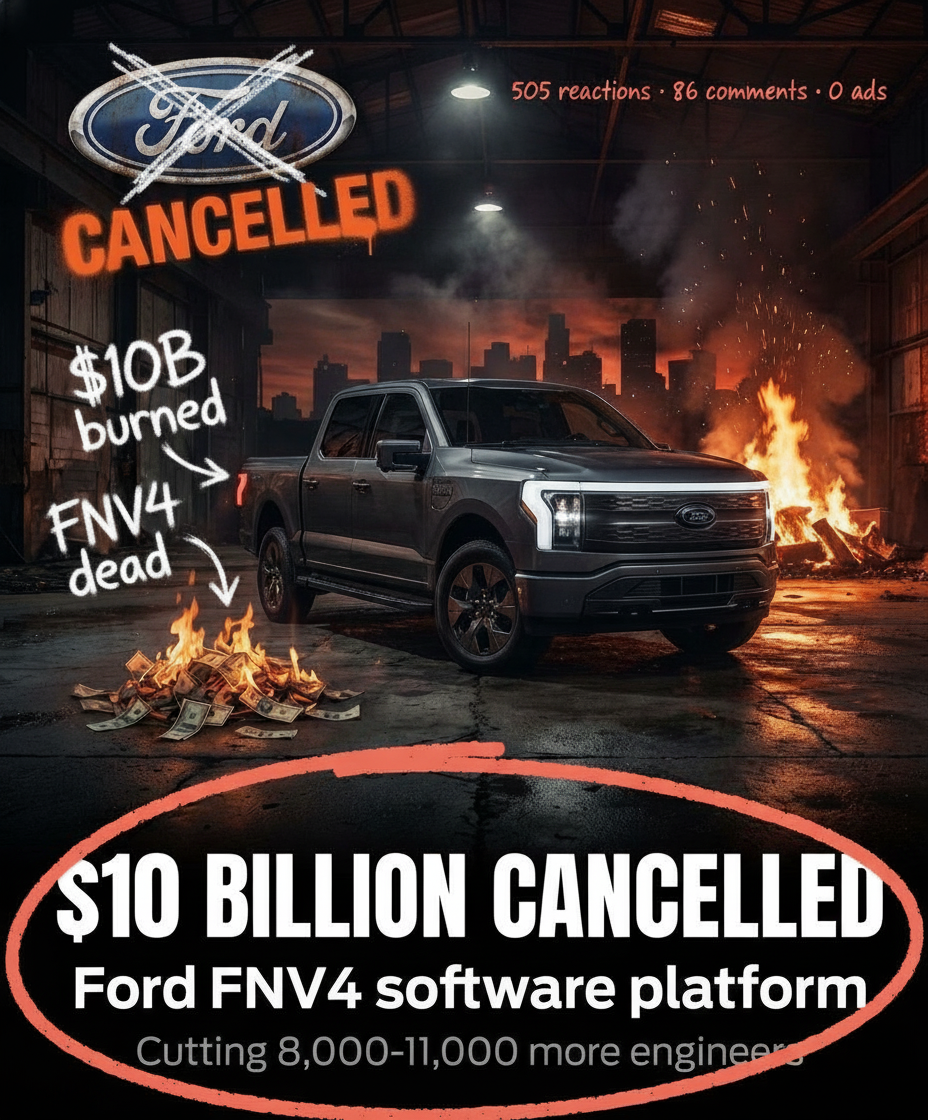
- The hook is one hard, dated fact. "Ford killed FNV4." A specific program, a verifiable event, an emotional payload in a handful of words. No adjective does any work — the fact does all of it. Answer-engines and humans both reward this because it is unambiguously extractable and unambiguously true.
- The structure is fact → pattern → cause → consequence. One shocking event, then the pattern it belongs to (the wider SDV struggle), then the deeper structural why, then what it means for the reader. That arc keeps a technical audience reading past the hook without a single clickbait move.
- The data is named and carefully hedged where it must be. Real program, real cause, and — critically — an honest frame on the money: reported multi-billion-dollar write-off, exact figure unconfirmed. Precision where it's verifiable, honesty where it isn't. That restraint is what makes insiders trust it instead of catching a wrong number.
- The point of view is earned, not borrowed. "I spent years inside the automotive engineering world." Insider authority beats outside analysis every time — the difference between commentary a VC scrolls past and commentary an OEM engineer forwards to their team.
- The restraint is the multiplier. No link in the body, no CTA, no "DM me." Pure value, let recognition do the work — the funnel link lives in the first comment. A post that asks for nothing gets shared; a post that sells gets skipped.
Virality on engineering-grade content is not volume or luck. It is a true, specific fact, told with earned authority and honest numbers, that lets the right people recognise their own reality — and then raise their hand.
The recipe: recreate this for your industry
This is the copy-paste part. Drop these prompts into Gemini or Claude, swap in your sector, and you have the same structure working for your own pipeline. The visual step is where most people leave value on the table — do not skip it.
- Find the story. "You are an industry analyst in [my sector]. List 5 recent events where a dominant incumbent quietly wrote off a huge bet — a cancelled platform, a killed program, a written-down architecture. For each: the hard fact, the date anchor, and why an insider would find it significant. Rank by how many people in the industry would recognise it instantly."
- Write the hook. "Turn event #1 into a single opening line: one hard number, one date anchor, under 12 words, zero adjectives. Give me 5 variants."
- Build the post. "Write a LinkedIn post using this arc: shocking fact → the pattern it belongs to (name 2 more real examples) → the structural cause → what it means for [my ICP]. First person, insider POV ('I spent years in…'), named data, no hedging, no CTA, no link in the body. 180–220 words."
- Make the visual value drip. "Here is a screenshot of the source report/headline. Using image editing, annotate it like a marked-up page: circle the key fact in coral, hand-draw an arrow to the second data point, add one short margin note in my handwriting-style font. Keep it looking real and captured, not like a slick data-viz card." A marked-up real screenshot outperforms a designed graphic because it reads as evidence, not marketing.
- Place the funnel link in the first comment — never the body — with your UTM parameters, so the reach compounds into tracked pipeline instead of leaking away.
Where this sits
The way to win in a market that just learned how hard SDV really is: say the true thing clearly and let the people living it raise their hands — then work the ones who do. That connects directly to the software-defined vehicle reality check and to founder-led GTM for deep-tech, and the mechanics of turning that recognition into pipeline are in turning LinkedIn engagement into B2B pipeline. If you sell into the industry specifically, see GTM for automotive-software founders.
FAQ
What was Ford's FNV4 and why did Ford cancel it?
FNV4 — fully-networked vehicle, gen four — was Ford's clean-sheet next-generation electrical and software architecture, the "electronic brain" meant to match Tesla on OTA updates and subscription features. Per Reuters reporting in 2025, Ford killed it over ballooning costs and persistent delays and folded the learnings into its current software system.
How much did Ford spend on FNV4?
There is no confirmed Ford disclosure of the exact program spend, and reported figures vary — some cite around ten billion dollars, but that isn't consistently attributed and appears to blend the program with wider losses. The attributable figure: Ford's software and EV losses totalled roughly $4.7B in a year, which FNV4 contributed to. In short, a reported multi-billion-dollar write-off.
Why is a clean-sheet SDV architecture so hard to build?
Because it's a platform every other program depends on at once — hardware, networking, OS, security and dozens of teams under one clock — while the old car business keeps shipping. Scope outruns schedule, integration cost compounds, and there's no revenue until the whole thing lands. Even Ford's resources couldn't force it through.
What does the FNV4 cancellation teach founders and suppliers?
That the hard part of SDV is integration, tooling and the cost of doing it at scale — which is exactly where the opportunity is. If a giant OEM can't easily build the platform in-house, the teams and tools that make SDV development cheaper, faster and provably lower-risk are selling into real, urgent pain. Lead with cost-out, speed and proof.
More on the engine behind this content: the loop — ingest, publish, mine, extract, reconcile, re-steer. One flat price, we ran it on ourselves first.