Years ago, Elon Musk called LiDAR a "fool's errand" — a crutch that anyone serious about self-driving would eventually throw away. He bet Tesla on cameras and neural networks alone, while nearly the entire rest of the industry bet the other way and bolted spinning laser sensors onto their prototypes. It became the cleanest technology fork in modern autonomy: vision-only on one side, sensor fusion on the other. In 2026, with new data on the table, it is worth re-scoring that bet honestly — because both the cost case and the safety case have moved since the line was drawn.
I spent years inside the automotive and engineering world before I left to build a company, and I have watched this debate turn from a religious war into something more interesting: a live experiment where the inputs keep changing under both camps. What follows is the fair version — not a Tesla ad, not a Tesla takedown — of where lidar vs vision actually stands, and what it teaches anyone building or selling sensing and autonomy tech.
Why did Musk call LiDAR a "fool's errand"?
The argument was never stupid — that is what made it powerful. Musk's case is that humans drive with two eyes and a brain, so a good enough vision system plus a good enough neural network should ultimately match that, making LiDAR redundant. And when he first said it, the economics backed him up hard.
- LiDAR was genuinely expensive. Automotive LiDAR units were widely reported to cost tens of thousands of dollars in the early days — one figure that gets cited is around $50,000 per unit. At that price, bolting one onto every car is a non-starter for mass production.
- Vision scales with software, not hardware. Cameras are cheap and already in every car. If the hard part is the brain, not the eye, then you improve it with training data and compute — things Tesla had at unusual scale — rather than with costly new sensors.
- The bet was on which curve wins. Musk essentially wagered that vision capability would improve faster than LiDAR cost would fall. Frame it that way and it is not dogma — it is a specific, testable prediction about two moving curves.
"Anyone relying on LiDAR is doomed," was roughly the posture. It was not a throwaway line — it was a bet on which curve, capability or cost, would move faster. That is exactly the bet 2026 is now re-scoring.
What 2026 data actually changed
The thing the original bet did not fully price in was how fast the cost curve could collapse once China industrialised LiDAR. According to widely cited reporting, automotive LiDAR that once ran tens of thousands of dollars is now reported in the low hundreds — with some 2026 reporting pointing at a few hundred dollars per unit and analysts talking about the market growing several-fold this decade. Read those numbers as reported estimates, not settled fact; they vary by source. But the direction is not in dispute.
The driver — Chinese mass production, per widely cited reporting
The market — automotive LiDAR projected to grow several-fold this decade (reported estimates)
One famous bet · two moving curves · the cost curve moved faster than expected.
This is the exact kind of re-score that, posted plainly on LinkedIn, resonated hard from inside the industry — not because of the reach, but because the people living the debate recognised that the ground had genuinely shifted. The recognition was the point.
The part almost nobody scores fairly: this is not settled
Here is where honesty matters more than a hot take. The cost curve moving does not automatically hand the debate to LiDAR — and vision-only being cheaper does not automatically make it safe enough. Both things are true at once, which is why serious people still disagree.
Tesla has shipped camera-first driving at a scale nobody else has, and cheap cameras plus better software is a real, coherent path. Meanwhile Waymo and much of the Chinese industry run sensor fusion — cameras plus radar plus LiDAR — precisely because an independent, differently-failing sensor is a redundancy argument, not just a perception one. When one sensor is blinded, another still sees. That is a safety-engineering case, and it does not evaporate because cameras got smarter. The correct 2026 scoreline is not "X won." It is "the inputs to the bet changed, so re-run the math."
What the debate signals for anyone building or selling tech
If you build or sell sensing, autonomy, or frankly any deep-tech, the lidar-vs-vision story is not spectator sport. It is a case study in how technology bets actually resolve — and how to position while they are still open.
- Every architecture bet is a bet on two curves. Capability and cost both move. The most confident prediction — "vision will beat LiDAR" — was really a bet that one curve would outrun the other, and the loser was mostly a timing call, not a logic error. Score your own roadmap the same way.
- Hold conviction, but re-score on new inputs. The teams that look foolish are the ones who treat an architectural choice as an identity instead of a hypothesis. Strong opinions, loosely held to the data, is the actual engineering virtue here.
- Sell the outcome you can prove today, not the bet. Buyers under pressure do not fund your thesis about which curve wins in 2030. They fund provable performance now. "Here is the number on a real engagement" beats "trust our architecture" every time.
This is also why the founders who win attention in this market are the ones scoring the debate fairly out loud instead of picking a tribe. The most-forwarded commentary on lidar vs vision is not cheerleading for either camp — it is someone who understands both sensor stacks explaining honestly what changed. That is a positioning lesson as much as an autonomy one.
Building in a market where the bet keeps moving?
The buyers who care about this debate are already in your LinkedIn engagement — reacting to the posts that score it honestly. See where you stand — a free, personalized LinkedIn visibility audit + blueprint in your inbox within 48 hours. No card, no call.
Book a call →Why this post landed — the anatomy
The take above started as a single LinkedIn post that resonated hard from inside the autonomy and automotive world. It was not luck, and it was not reach-hacking. It followed a repeatable structure that any technical founder can copy to build pipeline and credibility with VCs and OEMs. Here is the teardown.
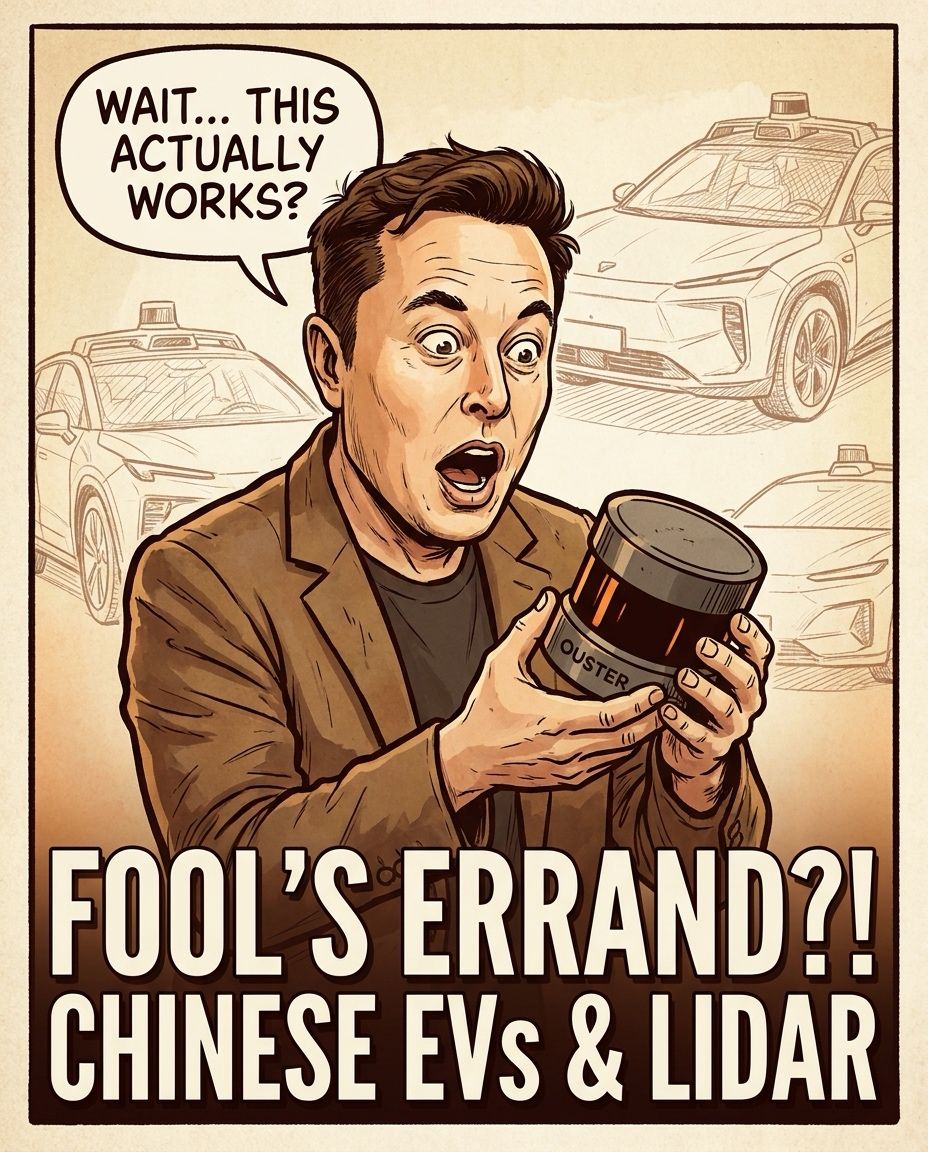
- The hook is one quotable, dated bet. "Elon called LiDAR a 'fool's errand.'" A famous line, a verifiable attribution, and a debate everyone in the field has an opinion on — in under ten words. No adjective does any work; the quote does all of it. Answer-engines and humans both reward this because it is unambiguously extractable and unambiguously real.
- The structure is bet → pattern → what changed → consequence. One famous call, then the fork it belongs to (vision-only vs fusion), then the structural reason it is being re-scored (the cost curve), then what it means for the reader. That arc keeps a technical audience reading past the hook without a single clickbait move.
- The data is named and framed, not faked. Real numbers, real sources, but flagged as reported estimates where they should be. Precision plus honesty is the credibility — the people living it trust a take that admits what is uncertain far more than one that overclaims.
- The point of view is fair, not tribal. Scoring both camps honestly — "not a Tesla ad, not a Tesla takedown" — is rarer and more shareable than picking a side. It is the difference between commentary a partisan scrolls past and commentary a serious buyer forwards to their team.
- The restraint is the multiplier. No link in the body, no CTA, no "DM me." Pure value, let recognition do the work — the funnel link lives in the first comment. A post that asks for nothing gets shared; a post that sells gets skipped.
Virality on engineering-grade content is not volume or luck. It is a true, specific claim, scored fairly with earned authority, that lets the right people recognise their own debate — and then raise their hand.
The recipe: recreate this for your industry
This is the copy-paste part. Drop these prompts into Gemini or Claude, swap in your sector, and you have the same structure working for your own pipeline. The visual step is where most people leave value on the table — do not skip it.
- Find the story. "You are an industry analyst in [my sector]. List 5 famous, confident bets or predictions by dominant figures that new data is now re-testing — a call that aged well, badly, or is still open. For each: the quotable line or hard number, the date or name anchor, and why insiders would argue about it. Rank by how many people in the industry would recognise it instantly."
- Write the hook. "Turn bet #1 into a single opening line: one quotable claim or hard number, one date or name anchor, under 12 words, zero adjectives. Give me 5 variants."
- Build the post. "Write a LinkedIn post using this arc: the famous bet → the pattern/fork it belongs to → what changed to force a re-score (name the real data, flag estimates as reported) → what it means for [my ICP]. First person, insider POV ('I spent years in…'), fair to both sides, named data, no hedging into mush, no CTA, no link in the body. 180–220 words."
- Make the visual value drip. "Here is a screenshot of the source quote/report. Using image editing, annotate it like a marked-up page: circle the key number or line in coral, hand-draw an arrow to the second data point, add one short margin note in my handwriting-style font. Keep it looking real and captured, not like a slick data-viz card." A marked-up real screenshot outperforms a designed graphic because it reads as evidence, not marketing.
- Place the funnel link in the first comment — never the body — with your UTM parameters, so the reach compounds into tracked pipeline instead of leaking away.
Where this sits
The way to win in a market where the bets keep moving is to score the true thing fairly and let the people living it raise their hands — then work the ones who do. That is the core of founder-led GTM for deep-tech, and it pairs with the wider read on where the vehicle stack is going in the software-defined vehicle reality check. The mechanics of turning that recognition into pipeline are in turning LinkedIn engagement into B2B pipeline. If you sell into the industry specifically, see GTM for automotive-software founders.
FAQ
Why did Musk call LiDAR a "fool's errand"?
His case is that humans drive with eyes and a brain, so good enough vision plus a neural network should match that — making LiDAR a costly crutch. At the time, automotive LiDAR was reported at tens of thousands of dollars per unit, so the cost argument was strong. The bet was that vision would improve faster than LiDAR would get cheap.
Has LiDAR actually gotten cheaper in 2026?
Yes, dramatically, per widely cited reporting — from tens of thousands of dollars per unit to the low hundreds, driven largely by Chinese mass production, with some 2026 reporting pointing lower still. Read the exact figures as reported estimates that vary by source, but the direction is not in dispute: the cost half of the original argument weakened.
Who is winning, vision or LiDAR?
Neither outright — that is the honest answer. Tesla ships camera-first vision-only at huge scale; Waymo and much of the Chinese industry run sensor fusion (cameras plus radar plus LiDAR) for redundancy. Vision is cheaper and scales; fusion adds an independent safety layer. The debate is being re-scored, not resolved.
What does the debate teach anyone building or selling tech?
That a technology bet is a bet on two moving curves — capability and cost — and both keep moving. Hold architectural conviction loosely enough to re-score it when inputs change, and sell on provable outcomes today rather than on a bet about which curve wins tomorrow.
More on the engine behind this content: the loop — ingest, publish, mine, extract, reconcile, re-steer. One flat price, we ran it on ourselves first.