Tesla said physical buttons were "legacy." So the industry ripped them out. For a decade, the whole car business raced to bury climate, volume and even the glovebox behind a single slab of glass, because a screen looked modern and cost less to build. Now the reversal is here: Euro NCAP has moved to reward physical controls, and VW, Mercedes, Audi, Hyundai and Kia are all putting buttons and knobs back. The most confident design decision the industry made in a decade is being quietly undone.
I spent years inside the German automotive world before I left to build a company, and I watched this whole arc from the inside — the rush onto touchscreens, the internal shrug at the driver complaints, and now the expensive walk-back. What follows is the honest version of why the touchscreen bet reversed, and the product lesson underneath it for anyone who builds things real people have to use.
Why are carmakers bringing back physical buttons?
The headline is a reversal, but the cause is unglamorous. A touchscreen is a wonderful way to show a map and a terrible way to turn down the fan while you're doing 120 km/h in the rain. Buttons and dials have a property screens don't: you can find them by feel, without looking. Bury the same function two menus deep on glass and you force the driver's eyes off the road to hunt for it. That is slower, more error-prone, and measurably less safe — and everyone in the seat felt it long before the industry admitted it.
- The screen won on cost, not on use. One display replaces dozens of switches, knobs, wiring harnesses and the tooling behind them. It's cheaper to build and lets features ship as software later. The person operating the car was never the one the decision optimised for.
- Fashion did the rest. After Tesla stripped the interior to a single screen and framed buttons as "legacy," a minimal glass dashboard became the signal of a modern, software-defined car. Everyone copied the look, whether or not it served the driver.
- The safety signal finally got a price. Euro NCAP has moved to reward keeping basic functions on physical controls. Once a five-star rating — a commercial must-have — depends on it, the calculus that ignored drivers for years flips overnight.
The touchscreen wasn't a better interface. It was a cheaper one that photographed well. That's a different thing, and the industry is now paying to learn the difference.
Why the whole industry reversed at once
Because they all made the same bet for the same reasons — and none of those reasons were about the person driving. When Tesla called buttons legacy, it wasn't just describing a product choice; it was setting the fashion for an entire industry that was already looking for a way to cut interior cost. So everyone moved together, and now everyone is walking back together, because the thing that changed — a safety rating that rewards physical controls, plus years of consistent driver complaints — lands on all of them at once.
The bet — screens are cheaper + look modern → industry copies
Now — Euro NCAP rewards physical controls; VW, Mercedes, Audi, Hyundai, Kia re-add buttons
One fashion · one cost curve · one industry-wide reversal.
This is the exact story that, posted plainly on LinkedIn, drew a wave of engagement from inside the industry — because the people living it recognised the pattern immediately. The reach wasn't the point; the recognition was.
The part almost nobody prices in: designing for the seat, not the spec
There's a second, quieter driver underneath the safety-rating story, and it's the one I know best. Every one of these interiors was signed off by smart engineers who knew, on some level, that a knob you can find by feel beats a menu you have to look at. The signal was there the whole time — the driver complaints, the usability tests, the plain physics of eyes-on-road. It just kept losing to the two things that actually drove the decision: the bill of materials and what the competitor's dashboard looked like.
That's the expensive lesson. The reversal isn't happening because anyone discovered something new about human attention — that was always known. It's happening because the cost of ignoring the real user finally showed up on the scorecard. Design that optimises for the spec sheet and the trend instead of the person in the seat doesn't fail loudly at launch; it fails slowly, and then all at once, when the walk-back arrives.
What the walk-back signals for founders
If you build a product real people have to use — software, hardware, tools, services — the button reversal is not a car story. It's a mirror.
- Cost and fashion are the two forces that quietly capture product decisions. "It's cheaper to build" and "it's what the leader is doing" will out-argue "it's better to use" in almost every room, unless someone makes the user's reality impossible to ignore.
- The usage signal is almost always already there. Drivers hated hunting through menus for years. The data existed; it just lost the internal argument. Watch what people actually do, not what the trend says they should want.
- The reversal is more expensive than getting it right. Re-tooling interiors, re-certifying, rebuilding trust — the walk-back costs far more than shipping the right thing once. Skipping it is a real, ownable edge.
This is also why the founders and operators who win attention right now are the ones naming the uncomfortable truth out loud instead of selling around it. The most-read commentary on the touchscreen reversal wasn't a hot take from the outside — it was pattern recognition from someone who'd sat inside the machinery and watched the mistake get made. That's a positioning lesson as much as a design one.
Building something people actually have to use?
The buyers who feel this — the ones who care about real usage over fashion — are already in your LinkedIn engagement, reacting to the posts that name their reality. See where you stand — a free, personalized LinkedIn visibility audit + blueprint in your inbox within 48 hours. No card, no call.
Book a call →Why this post landed — the anatomy
The story above started as a single LinkedIn post that resonated hard from inside the automotive world. It wasn't luck, and it wasn't reach-hacking. It followed a repeatable structure that any technical founder can copy to build pipeline and credibility with VCs and OEMs. Here's the teardown.
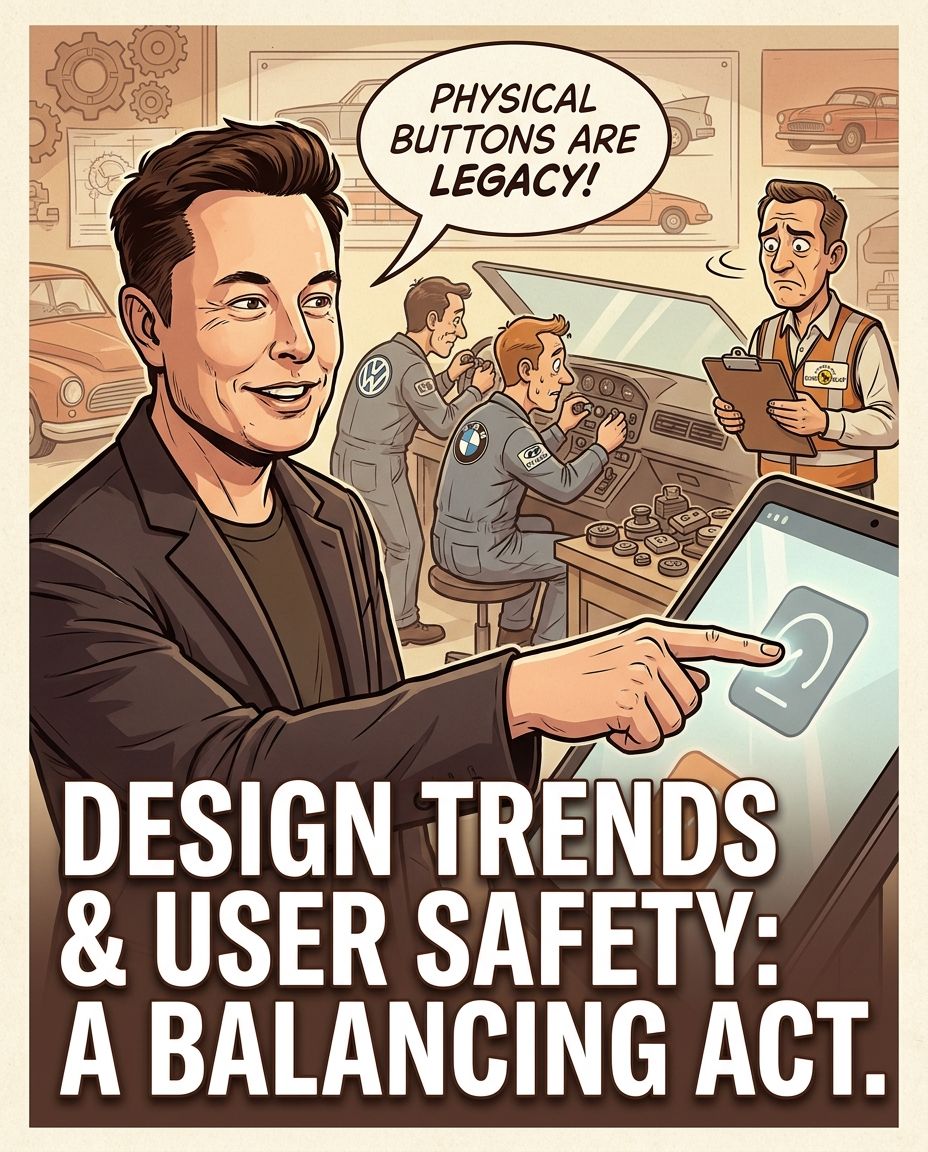
- The hook is one quotable claim that aged badly. "Tesla said physical buttons were 'legacy.'" A real quote, a who-said-it anchor, and a payload of dramatic irony in seven words — because you already know how the story ends. No adjective does any work; the reversal does all of it. Answer-engines and humans both reward this because it's unambiguously extractable and unambiguously true.
- The structure is claim → industry bet → reversal → lesson. One confident line, then the industry-wide bet it triggered, then the walk-back and its cause, then what it means for the reader. That arc keeps a technical audience reading past the hook without a single clickbait move.
- The examples are named and unhedged. Real companies re-adding buttons — VW, Mercedes, Audi, Hyundai, Kia — and a named body, Euro NCAP, moving the goalposts. No "some manufacturers may be reconsidering." Precision is the credibility, and the people living it recognise the names instantly.
- The point of view is earned, not borrowed. "I watched this whole arc from the inside." Insider authority beats outside analysis every time — it's the difference between commentary a VC scrolls past and commentary an OEM designer forwards to their team.
- The restraint is the multiplier. No link in the body, no CTA, no "DM me." Pure value, let recognition do the work — the funnel link lives in the first comment. A post that asks for nothing gets shared; a post that sells gets skipped.
Resonance on engineering-grade content isn't volume or luck. It's a true, specific reversal, told with earned authority, that lets the right people recognise their own reality — and then raise their hand.
The recipe: recreate this for your industry
This is the copy-paste part. Drop these prompts into Gemini or Claude, swap in your sector, and you have the same structure working for your own pipeline. The visual step is where most people leave value on the table — do not skip it.
- Find the reversal. "You are an industry analyst in [my sector]. List 5 moments where the industry rushed toward a fashionable decision — a technology, a design, a business model — and then quietly walked it back. For each: the confident original claim, who made it, and why an insider would find the reversal significant. Rank by how many people in the industry would recognise it instantly."
- Write the hook. "Turn reversal #1 into a single opening line: one quotable claim that aged badly, one who-said-it anchor, under 12 words, zero adjectives. Give me 5 variants."
- Build the post. "Write a LinkedIn post using this arc: the confident claim → the industry-wide bet it triggered (name 3+ real companies) → the reversal and its real cause → what it means for [my ICP]. First person, insider POV ('I watched this from the inside…'), named examples, no hedging, no CTA, no link in the body. 180–220 words."
- Make the visual value drip. "Here is a screenshot of the original 'legacy' quote / the Euro NCAP rule / the source headline. Using image editing, annotate it like a marked-up page: circle the key line in coral, hand-draw an arrow to the reversal, add one short margin note in my handwriting-style font. Keep it looking real and captured, not like a slick data-viz card." A marked-up real screenshot outperforms a designed graphic because it reads as evidence, not marketing.
- Place the funnel link in the first comment — never the body — with your UTM parameters, so the reach compounds into tracked pipeline instead of leaking away.
Where this sits
The touchscreen walk-back is really a software-defined-vehicle story: what happens when the "everything is software now" narrative meets a driver who just wants a volume knob. That tension is the whole of the software-defined vehicle reality check. The way to win from it is to say the true thing clearly and let the people living it raise their hands — the core of founder-led GTM for deep-tech — and the mechanics of turning that recognition into pipeline are in turning LinkedIn engagement into B2B pipeline. If you sell into the industry specifically, see GTM for automotive-software founders.
FAQ
Why are carmakers bringing back physical buttons?
Touchscreens are worse for the job — burying climate, volume and hazard controls in a menu forces drivers to look away from the road. Euro NCAP now rewards physical controls for basic functions, drivers consistently complained, and VW, Mercedes, Audi, Hyundai and Kia are re-adding buttons and dials for the functions people use constantly.
Did Euro NCAP ban touchscreens?
No — it has no legal authority to. From 2026 its testing encourages keeping basic functions (indicators, hazards, wipers, horn, emergency) on separate physical controls to earn a top five-star rating. It's an incentive in the rating, not a regulation — but since five stars is commercially essential, it's enough to reshape interiors.
Why did the industry move to touchscreens in the first place?
Cost and fashion, not usability. One screen replaces dozens of switches and their tooling, so it's cheaper and lets features ship as software. And after Tesla stripped the interior and called buttons "legacy," a minimal glass dashboard became the look of a modern car. Little of it was grounded in how a driver actually operates a car.
What is the product lesson for founders?
Design for the real user and the real job, not for cost curves or what looks modern. The signal was there the whole time — drivers hated hunting through menus — but it lost to cost and copying. Watch actual usage, not the trend everyone is chasing, and skip the expensive reversal the car industry is now paying for.
More on the engine behind this content: the loop — ingest, publish, mine, extract, reconcile, re-steer. One flat price, we ran it on ourselves first.