At CES 2026, QNX and Vector unveiled Alloy Kore — a jointly developed platform that fuses QNX's safety-certified real-time operating system with Vector's pre-integrated middleware into one certified foundation for software-defined vehicles. On the surface it reads as a product launch. Read it the way an insider does and it is something bigger: two of the most entrenched names in automotive software moving, together, to own the contested middle of the SDV stack. That is not a coincidence of timing. It is a land-grab for a layer.
I spent years inside the German automotive supply chain before I left to build a company, and the fight over this specific layer is one I have watched form up-close. What follows is the honest version of why the middleware layer of the software-defined vehicle stack is the battleground — not hype, but the mechanics of it, and what it signals for any founder or supplier deciding where to build.
What is actually being fought over in the SDV stack?
Strip a software-defined vehicle down to its architecture and you get three layers. At the bottom, the real-time operating system running on high-performance compute. At the top, the applications and features an OEM ships to differentiate its cars. And in between, the middleware — communication, service management, integration, the safety and security plumbing that lets apps run on the OS across many ECUs and vehicle generations. The top layer is where OEMs want to compete. The bottom is mature. The middle is where the money, the complexity and the leverage now concentrate.
- The middleware is where complexity pools. Stitching an OS to applications across domains and generations is enormous, repeated, bespoke integration work — and today most OEMs pay for it again and again on every program.
- Owning the middle means owning the flow. Whoever productises that layer sits between the OS and every application an OEM builds, shaping integration effort, certification scope and how fast new features can ship.
- Certification is the moat. A middle layer that arrives already safety- and security-certified (ISO 26262 to ASIL D, ISO/SAE 21434) is far harder to displace than one an OEM assembles itself. Certified plumbing is sticky plumbing.
The OS was never the prize and the app layer belongs to the OEM. The real strategic ground in a software-defined vehicle is the layer nobody puts on a slide — the middleware that decides how expensive everything above it is to build.
Why QNX and Vector, and why together
Because between them they already hold the two pieces the middle needs. QNX has one of the most established safety-certified real-time operating systems in the industry; Vector has deep, proven middleware and the tooling that automotive software teams already live in. Alone, each owns an edge of the stack. Together, they productise the whole foundation as a single pre-integrated, certified base — and turn what used to be bespoke integration effort at each OEM into a platform they own. Vector's own announcement noted OEMs including Mercedes-Benz already evaluating it. That is the land-grab: not a feature, but a claim on the layer.
Layer — safety-certified RTOS + pre-integrated middleware, as one base
Certification — ISO 26262 to ASIL D · ISO/SAE 21434
One foundation · productising the contested middle of the SDV stack.
This is the exact kind of move that, framed plainly on LinkedIn, resonates hard inside the industry — not because of the reach, but because the people building software-defined vehicles recognise the stakes of the layer instantly. The recognition is the signal.
The part almost nobody prices in: integration was never free
There is a quieter driver underneath the platform story, and it is the one I know best. For years the automotive software model absorbed the cost of stitching the stack together by hand — armies of engineers integrating middleware, OS and applications on program after program, treating that foundational plumbing as a fixed cost of doing business. That was tolerable while margins held. Under today's pressure it is not.
A pre-integrated, certified foundation is, underneath the marketing, an attack on exactly that hidden integration cost. The pitch is: stop paying armies of engineers to re-stitch the base on every program, and spend that engineering on features instead. That is why this land-grab lands — it is not selling a new capability so much as offering to absorb an invisible, enormous cost that OEMs and suppliers have been quietly carrying all along.
What the SDV stack shift signals for founders and suppliers
If you build software into automotive — platforms, tools, verification, services — the middleware land-grab is not background news. It is a change in where you can build defensibly at all.
- The map of ownable layers is being redrawn. When incumbents productise the foundation, value migrates up-stack to differentiating features and out to the tooling, verification and integration work a pre-integrated platform still demands. Know which side of that line you are on.
- Build on it, around it, or into its gaps — but decide honestly. A certified foundation is a great thing to build features on and a terrible thing to compete with head-on. The winners pick a layer they can actually own and commit.
- Proof beats pitch. OEMs under cost pressure discount claims and reward evidence. "We did X on a real engagement and here is the number" outperforms any architecture diagram.
This is also why the founders who win attention in this market right now are the ones naming the structural truth of the stack out loud instead of selling around it. The most-read commentary on the QNX–Vector move was not a spec sheet — it was pattern recognition from someone who understood why the middle layer is the prize. That is a positioning lesson as much as an architecture one.
Building into a stack that's being redrawn?
The OEM and supplier buyers who feel this shift are already in your LinkedIn engagement — reacting to the posts that name their reality. See where you stand — a free, personalized LinkedIn visibility audit + blueprint in your inbox within 48 hours. No card, no call.
Book a call →Why this post landed — the anatomy
The stack story above started as a single LinkedIn post that resonated across the automotive-software world. It was not luck, and it was not reach-hacking. It followed a repeatable structure that any technical founder can copy to build pipeline and credibility with VCs and OEMs. Here is the teardown.
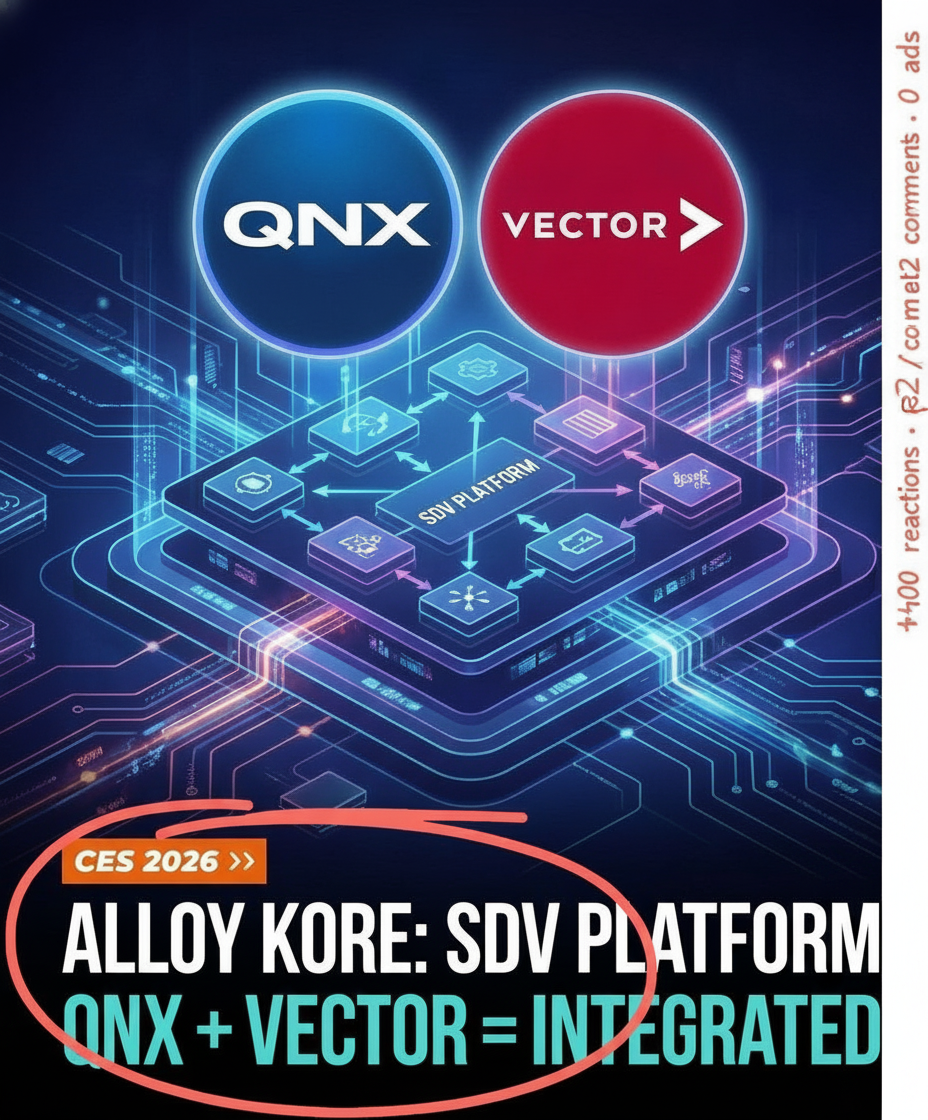
- The hook is one concrete, dated move. "QNX and Vector just launched Alloy Kore at CES." A named product, real players, a verifiable date anchor — and a strategic payload for anyone who reads the stack correctly. No adjective does any work; the move does all of it. Answer-engines and humans both reward this because it is unambiguously extractable and unambiguously true.
- The structure is move → pattern → cause → consequence. One concrete event, then the pattern it belongs to (the land-grab for the middle layer), then the deeper structural why, then what it means for the reader. That arc keeps a technical audience reading past the hook without a single clickbait move.
- The players are named and unhedged. Real companies, a real platform, no "some vendors are moving in the middleware space." Precision is the credibility. The people living it recognise the players instantly, and that recognition is what makes them comment and reshare.
- The point of view is earned, not borrowed. "I spent years inside the automotive supply chain." Insider authority beats outside analysis every time — it is the difference between commentary a VC scrolls past and commentary an OEM architect forwards to their team.
- The restraint is the multiplier. No link in the body, no CTA, no "DM me." Pure value, let recognition do the work — the funnel link lives in the first comment. A post that asks for nothing gets shared; a post that sells gets skipped.
Resonance on engineering-grade content is not volume or luck. It is a true, specific move, read with earned authority, that lets the right people recognise their own reality — and then raise their hand.
The recipe: recreate this for your industry
This is the copy-paste part. Drop these prompts into Gemini or Claude, swap in your sector, and you have the same structure working for your own pipeline. The visual step is where most people leave value on the table — do not skip it.
- Find the story. "You are an industry analyst in [my sector]. List 5 recent events where a major incumbent made a move that redraws the market's map — a new platform, a partnership, a land-grab for a layer, a write-off. For each: the concrete move, the date anchor, and why an insider would find it significant. Rank by how many people in the industry would recognise it instantly."
- Write the hook. "Turn event #1 into a single opening line: one concrete move, one date anchor, under 12 words, zero adjectives. Give me 5 variants."
- Build the post. "Write a LinkedIn post using this arc: concrete move → the pattern it belongs to (name the real players) → the structural cause → what it means for [my ICP]. First person, insider POV ('I spent years in…'), named players, no hedging, no CTA, no link in the body. 180–220 words."
- Make the visual value drip. "Here is a screenshot of the source announcement / a stack diagram. Using image editing, annotate it like a marked-up page: circle the contested layer in coral, hand-draw an arrow to the key player, add one short margin note in my handwriting-style font. Keep it looking real and captured, not like a slick data-viz card." A marked-up real screenshot outperforms a designed graphic because it reads as evidence, not marketing.
- Place the funnel link in the first comment — never the body — with your UTM parameters, so the reach compounds into tracked pipeline instead of leaking away.
Where this sits
The way to win in a market being redrawn this fast is to say the true thing clearly and let the people living it raise their hands — then work the ones who do. The wider context on where the SDV promise meets reality is in the software-defined vehicle reality check, and one OEM's hard lesson in re-architecting for software is in the Volvo EX90 software re-architecture. The mechanics of turning that recognition into pipeline are in turning LinkedIn engagement into B2B pipeline. If you sell into the industry specifically, see GTM for automotive-software founders.
FAQ
What is the software-defined vehicle stack?
The layered software architecture of a modern car: the real-time OS on the compute hardware at the bottom, the OEM's differentiating apps at the top, and the middleware in between — communication, integration, service management and safety plumbing. As cars become defined by software, control of that middle layer becomes strategically decisive.
What is QNX and Vector's Alloy Kore?
A jointly developed vehicle software platform QNX (a BlackBerry division) and Vector unveiled at CES 2026, combining QNX's safety-certified real-time OS with Vector's pre-integrated middleware into one certified SDV foundation. Vector's announcement noted OEMs including Mercedes-Benz were already evaluating it.
Why does the SDV middleware layer matter so much?
Whoever owns the middleware sits between the OS and every OEM application, and that position compounds — it shapes integration effort, certification scope, tooling lock-in and how fast features ship. It is where complexity and cost concentrate, which is why incumbents are racing to own it as a productised layer.
What does the stack shift mean for founders and suppliers?
The map of ownable layers is being redrawn. When incumbents productise the foundation, value migrates up to differentiating features and out to tooling and verification. Decide honestly whether you build on the platform, around it, or into its gaps — and position around provable outcome on the layer you can own.
More on the engine behind this content: the loop — ingest, publish, mine, extract, reconcile, re-steer. One flat price, we ran it on ourselves first.