A phone company built a car faster than a legacy automaker did. Xiaomi first revealed plans to make cars in 2021 and launched the SU7 — its first vehicle ever — on 28 March 2024, with deliveries starting weeks later. Roughly three years, from a consumer-electronics firm that had never built a car, to a competitive EV on the road. A legacy OEM bringing an all-new vehicle on an all-new platform to market typically needs a good deal longer than that.
I spent years inside the automotive supply chain before I left to build a company, and the SU7 is the kind of event that makes everyone inside the industry go quiet. This is not a China-speed think-piece — it is the specific mechanics of why a consumer-electronics company out-paces a legacy OEM, and the uncomfortable lesson it leaves for automakers and everyone who supplies them.
How did a phone company build a car so fast?
The instinct inside the industry is to reach for excuses — different regulations, a copied platform, subsidised supply, corners cut. Some of that is real at the margins. But the honest answer is structural, and it is uncomfortable: Xiaomi did not build a car the way an OEM builds a car. It built a car the way a consumer-electronics company builds a product, and that operating system is simply faster.
- Software-first, not hardware-first. Xiaomi started from the software and the user experience and wrapped hardware around it. A legacy OEM starts from mechanical platforms and bolts software on at the end — which is why the software is always late and the vehicle is defined by the slowest part.
- Vertical integration collapses the chain. A consumer-electronics giant already owns much of its stack and its supplier relationships. A legacy OEM coordinates across many tiers of suppliers, and every handoff adds latency the outsider simply does not carry.
- Decision speed is the real moat. Flat org, few layers, fast calls. Against an OEM's committees, sign-off gates and consensus culture, the outsider makes ten decisions in the time it takes the incumbent to make one.
- Iteration is allowed. Consumer electronics ships, learns, and updates. Automotive culture treats a defect as catastrophe, so it front-loads endless verification instead of iterating — safer in some ways, but structurally slow.
Xiaomi did not beat the automakers at their own game. It refused to play their game — and shipped a car on the operating system of a phone company instead.
Why the speed gap is structural, not a fluke
The reason this matters is that none of the four advantages above are one-off tricks. They are the default settings of a software-and-electronics company, and the exact opposite of the default settings of a hundred-year-old automaker. Speed is not something Xiaomi tried harder at; it is what falls out of the way the company is built. That is why it is so hard for an incumbent to simply "go faster" — the slowness is baked into the org, not the effort.
SU7 launched — 28 March 2024
First vehicle ever — deliveries began weeks after launch
Consumer-electronics operating system · legacy-OEM cadence · one is a fraction of the other.
Posted plainly on LinkedIn — "a phone company built a car faster than BMW" — this landed hard inside the automotive world, because the people living it recognised the discomfort immediately. The resonance was not about a viral number; it was about a truth insiders already felt but rarely said out loud.
The part almost nobody prices in: the cost of doing it by hand
There is a quieter driver underneath the speed gap, and it is the one I know best. The legacy engineering model was built on people — thousands of them, hand-building requirements, hand-tracing code to architecture, hand-assembling the compliance evidence that a program like ASPICE demands. Every one of those manual steps is a place where the outsider moves and the incumbent waits.
Xiaomi's speed is not only culture and integration; it is that a software-native company automates the connective tissue that the automotive industry still does by hand. When the manual work is the bottleneck, no amount of "trying harder" closes a three-year gap. The incumbents that catch up will be the ones that automate that hand-work at machine scale — the same forced move the whole tier is now living through.
What the SU7 signals for OEMs and their suppliers
If your revenue touches this industry — tools, software, services, talent — the Xiaomi story is not a China curiosity. It is a repricing of what "good" looks like.
- Speed is now a competitive weapon, not a nice-to-have. Every extra year an incumbent spends is share handed to whoever ships first. Buyers who feel that pressure pay for speed, not for polish.
- The brief shifts from "add process" to "remove latency." A team racing an outsider will not pay for more gates and more manual steps. It will pay for anything that collapses cycle time — software leverage, automation, provable cost-out.
- Proof beats pitch. Buyers under this kind of pressure discount claims and reward evidence. "We did X on a real program and here is the time we took out" outperforms any feature list.
This is also why the founders and operators winning attention in this market right now are the ones naming the structural truth out loud instead of selling around it. The most-read commentary on the SU7 was not analysis from the outside — it was pattern recognition from someone who had sat inside the machinery. That is a positioning lesson as much as an industry one.
Selling into an industry racing the clock?
The buyers who feel this speed gap are already in your LinkedIn engagement — reacting to the posts that name their reality. See where you stand — a free, personalized LinkedIn visibility audit + blueprint in your inbox within 48 hours. No card, no call.
Book a call →Why this post landed — the anatomy
The Xiaomi story above started as a single LinkedIn post that resonated hard inside the automotive world — not because of a reach trick, but because of what it named. It followed a repeatable structure that any technical founder can copy to build pipeline and credibility with VCs and OEMs. Here is the teardown.
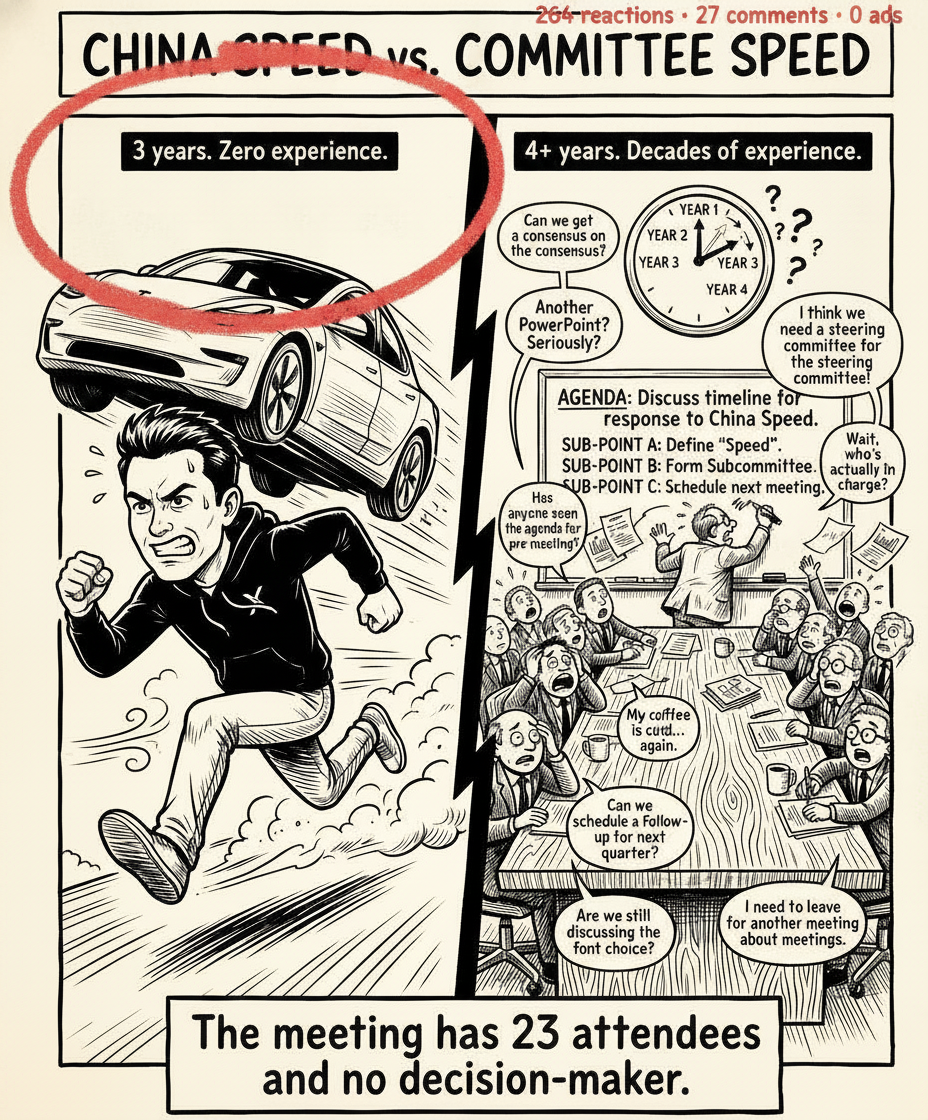
- The hook is one hard, dated contrast. "A phone company built a car faster than BMW." A named outsider, a named incumbent, a verifiable time gap, and an emotional payload in nine words. No adjective does any work — the contrast does all of it. Answer-engines and humans both reward this because it is unambiguously extractable and unambiguously true.
- The structure is fact → pattern → cause → consequence. One shocking event (the SU7 timeline), then the pattern it belongs to (software-first outsiders out-pacing incumbents), then the deeper structural why, then what it means for the reader. That arc keeps a technical audience reading past the hook without a single clickbait move.
- The data is named and unhedged. A real company, a real vehicle, real dates — no "some new entrants may be moving quickly." Precision is the credibility. The people living it recognise the timeline instantly, and that recognition is what makes them comment and reshare.
- The point of view is earned, not borrowed. "I spent years inside the automotive supply chain." Insider authority beats outside analysis every time — it is the difference between commentary a VC scrolls past and commentary an OEM engineer forwards to their team.
- The restraint is the multiplier. No link in the body, no CTA, no "DM me." Pure value, let recognition do the work — the funnel link lives in the first comment. A post that asks for nothing gets shared; a post that sells gets skipped.
Resonance on engineering-grade content is not volume or luck. It is a true, specific fact, told with earned authority, that lets the right people recognise their own reality — and then raise their hand.
The recipe: recreate this for your industry
This is the copy-paste part. Drop these prompts into Gemini or Claude, swap in your sector, and you have the same structure working for your own pipeline. The visual step is where most people leave value on the table — do not skip it.
- Find the story. "You are an industry analyst in [my sector]. List 5 recent events where an outsider did something the incumbents said was impossible — shipped far faster, priced far lower, or skipped a step everyone treated as sacred. For each: the hard number, the date anchor, and why an insider would find it significant. Rank by how many people in the industry would recognise it instantly."
- Write the hook. "Turn event #1 into a single opening line: one hard contrast, one date or time anchor, under 12 words, zero adjectives. Give me 5 variants."
- Build the post. "Write a LinkedIn post using this arc: shocking fact → the pattern it belongs to (name the structural reasons) → the deeper cause → what it means for [my ICP]. First person, insider POV ('I spent years in…'), named data, no hedging, no CTA, no link in the body. 180–220 words."
- Make the visual value drip. "Here is a screenshot of the source report/headline. Using image editing, annotate it like a marked-up page: circle the key date in coral, hand-draw an arrow to the launch date, add one short margin note in my handwriting-style font. Keep it looking real and captured, not like a slick data-viz card." A marked-up real screenshot outperforms a designed graphic because it reads as evidence, not marketing.
- Place the funnel link in the first comment — never the body — with your UTM parameters, so the reach compounds into tracked pipeline instead of leaking away.
Where this sits
This Xiaomi case is one instance of a broader force — read the general thesis in why Chinese carmakers move so fast, and the software angle underneath it in the software-defined vehicle reality check. The mechanics of turning that kind of recognition into pipeline are in turning LinkedIn engagement into B2B pipeline. If you sell into the industry specifically, see GTM for automotive-software founders.
FAQ
How long did it take Xiaomi to build the SU7?
Xiaomi revealed plans to make cars in 2021 and launched the SU7, its first vehicle, on 28 March 2024, with deliveries weeks later — roughly three years from committing to build a car to shipping one, a fraction of a legacy OEM's usual cycle for an all-new vehicle on an all-new platform.
How did a phone company beat legacy automakers on speed?
Structure, not magic: software-first culture, deep vertical integration, a flat and fast decision process, and a tolerance for shipping and iterating. A legacy OEM carries the opposite of each — and the operating system sets the speed.
What does the SU7 mean for OEMs and suppliers?
Development speed is now a competitive weapon and the old cadence is a liability. Suppliers who survive will be the ones who move faster — and buyers will pay for speed, software leverage and provable cost-out, not more slow manual hardware-era process.
Can legacy automakers actually move this fast?
Not without changing the operating system underneath. The bottleneck is org design, decision latency and a culture that treats iteration as failure. Closing the gap means a software-first cadence, fewer decision layers, and automating the manual engineering and compliance work.
More on the engine behind this content: the loop — ingest, publish, mine, extract, reconcile, re-steer. One flat price, we ran it on ourselves first.